Transcript for the video 'Professional Services in 2027':
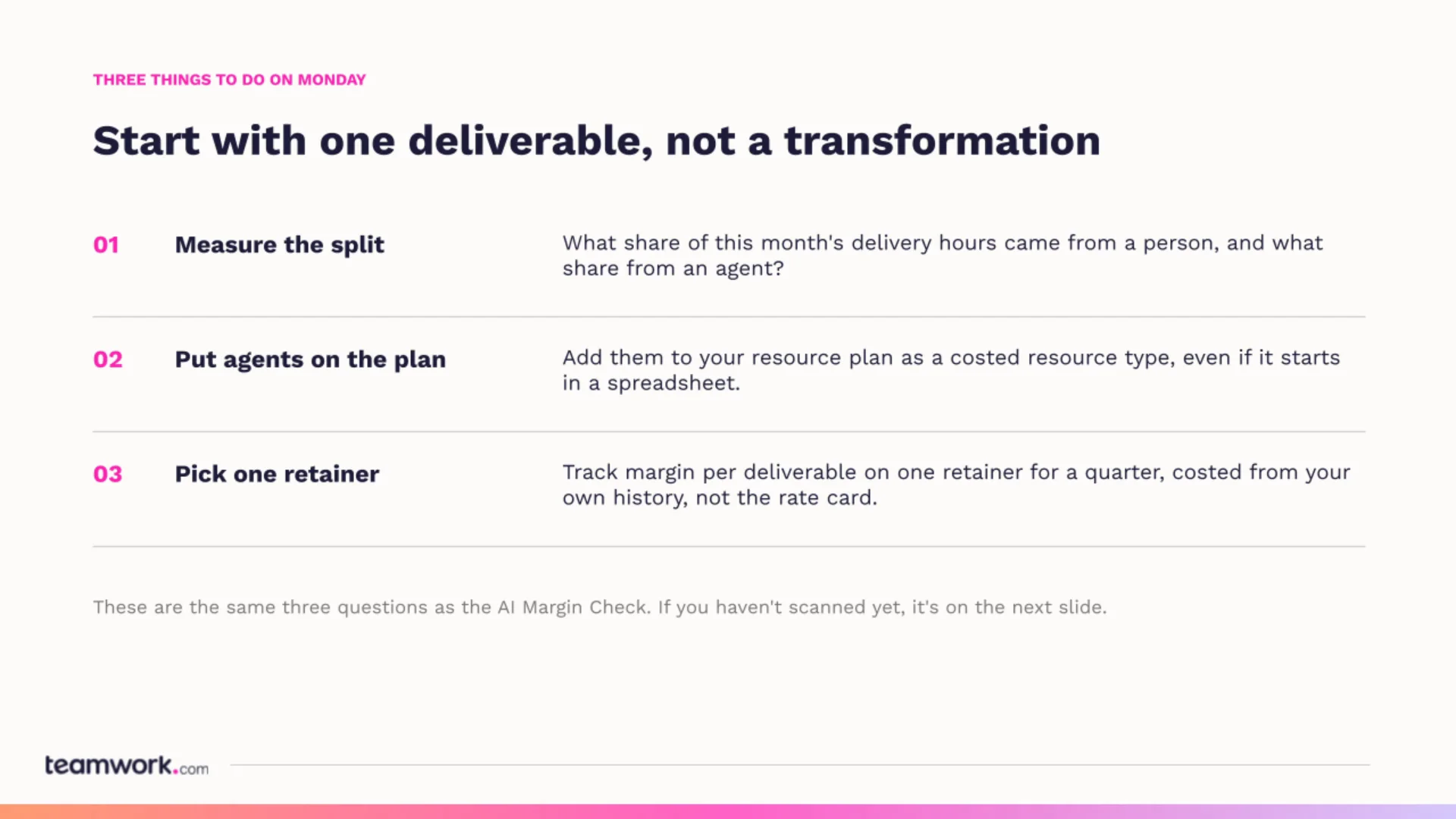
You're all very welcome to join us here today for an exciting webinar about the consultancy of the future and how AI can have a transformative effect on the margins of professional services and consulting firms. So today, we're tackling the question that's on the lips of every services leader right now. While AI might be making delivery faster, the question is, where do the savings go? Are they going to your margin? Are they quietly disappearing or accruing back to your client? So a couple of quick housekeeping tips. Do please feel free to drop your questions into the Q and A as we go. We'll answer as many of them as we can live and we'll follow-up for the rest afterwards. And obviously, we're recording here, so everyone registered will get the recording afterwards, and we'll send that on to you. My name is Masi Omani. I lead the the customer facing org here at Teamwork. Been at Teamwork for a number of years now, working with lots of professional services orgs really to try and understand how they can leverage technology to drive better financial outcomes, better billable utilization, better client and project profitability, better on time delivery. I'm also joined by my colleague Jane Eston who I'll let present herself. Thank you Mosse. Hello all, thank you so much for taking some time out of your day to join us here today. So as Mosse mentioned, I'm head of product here at Teamwork. So I get the pleasure of speaking with an awful lot of our customers and actually determining how we build teamwork in order to solve a lot of the problems that Mosse has mentioned now. So I'll get the lovely job later on in the session to actually demonstrate how we do that today for a number of our customers. Excellent. Thanks Jane. I wanted to start off by actually sharing some insights gathered from a professional services event that was at a couple of weeks ago really and that event, it was just leaders of large professional services firms, and we asked them three questions about how AI is impacting on margin. So firstly, you can clearly see how AI is impacting on costs to deliver work, right? Most people just really have no idea and they're guessing at best. The second question we ask is how is AI impacting on how professional services firms are pricing for work? And this one actually surprised me that over three quarters are still pricing by the hour, whereas I would have expected a lot more moving towards fixed fee or billable milestones or even outcome based pricing. So the majority here are still pricing by the hour. And then thirdly, how is AI impacting on how consulting firms and professional services firms are actually planning capacity? And as you can see here, almost nobody is actually running a blended model where they're actually able to plan with humans and AI agents together. And most are still planning capacity purely around people. So while pricing approaches are starting to shift, cost visibility just hasn't caught up the gap between where the margin and the risk sits. And nobody we asked had a clear view of AI margin and how AI is impacting margins. So really, that's what this session is all about. It's the opportunity that AI presents to be the biggest margin lever perhaps ever for consulting and professional services firms. And it's not just what we're hearing in conversations with our clients. SPI Research are a large professional services research firm in North America with a global reach, and they've just published their 2026 report on how AI is impacting professional services firms. And as you can see here, the numbers are broadly telling a similar story. AI is helping firms save time, but not really helping them make more money just yet. So they can see here that it's a huge efficiency gain, but not impacting on how generating revenue or improving margins. So that really is where the opportunity lies. It might be making firms more efficient, but it's not making them more profitable just yet. And some of this isn't new, right? For forever and a day inside professional services firm, the challenge has actually been the commercial side of the business sells it with a big fat healthy margin, maybe, upwards 30%, 40%. The delivery side of the house is happy if they get their work delivered on time and largely on budget. And the finance side of the house is happy if they get it invoiced and they get the money collected in a reasonable time frame. But the challenge with all of that is you can do all those things well, but you may not be making a healthy margin. Oftentimes the challenge is your best product project manager can tell you if a project is on track, but nobody can generally tell you whether you're making healthy margins as you deliver it. So let's take a typical scenario, right? I'm sure most people on the call here are probably familiar with this. It's fine until your plan meets reality, right, and very few plans survive contact reality because clients change things and AI or not that will never change. So we see scenarios where the client moves a go live or a delivery date out by a couple of weeks, but the people you had on the project, they're still booked. Suddenly the utilization falls, the next job starts late, the billing dates move, and now your margins are heavily impacted. And the challenge in all of this is that when all of these things do happen, finance doesn't see it on time. They see it after the project is finished or only at month end. And by then, it's too late. You can't do anything about it. And this is an age old problem, right? Margin is lost in delivery but not really explained until after the fact. So as I was mentioning, often you sell the project with a healthy margin upfront But actually the challenge is that by the time you report on the project after the fact, that margin has been largely eroded away. So the month end numbers may be correct, but by the time you get them, they're too late to act upon. And really this was all avoidable, right? It's often avoidable if you're getting your real time insights on how things are being delivered during the project itself when you still have some time to do something about it. Now AI can change a lot of this, right? Firstly, where does AI come into from a pricing perspective, right? Well, as we just mentioned, what we're largely seeing here is that AI is certainly helping deliver stuff faster, but actually that's just resulting in less billable hours. So if most consulting firms continue to actually sell time and materials engagements, they're just going to see fewer hours with smaller invoices, but similar costs. And so that just results in shrinking revenue. And the definition of insanity and all that, you know, continue to do the same thing over expecting different results. So the beauty of AI in this scenario is that it gives you options. And really in business, that's what we're looking for. We're looking for optionality. So the first option, if you're able to actually plan with AI in the mix is that it actually helps you deliver healthier margins, right? Because it should, in theory, if you're selling more fixed fee or buildable milestones or even outcome based pricing engagement, it means the fee holds, but if you're leveraging AI to deliver it, the delivery costs should fall. So ultimately you're getting the return here of healthier margins while reaping the benefit of using AI to deliver the work. So that's the first option it gives you. The second option is you can choose to leverage the savings that AI gives you to be more competitive. Often we're in a scenario where to win the work you want to price more competitively. You might be able to take on more work and win more contracts by doing this, but it's hard when you're paying for people's costs and you have to sustain certain margins. So if you're able to plan with AI as part of the delivery mix, then that just means you can price sharper while still holding a healthy margin and take on and win work that your competitors simply can't compete for. So really what starts to change when you're able to actually start to think of your AI agents as part of your resourcing and your people mix is that it gives you margin options and ways to increase margin and win more business. So this is really the big mindset shift that we're starting to see in the more AI forward and progressive consulting firms. The traditional utilization dashboard upon which so many professional services orgs have relied upon for so long is sadly about to start to lie to us. And the reason for that is that we like to call this the denominator problem is if agents actually start to absorb maybe a quarter or a third of the low end repeatable work inside a services firm, your most AI forward team members may actually start to look like your worst utilized people. So the people who are actually making the best use of the technology to deliver the work more efficiently actually start to look worse from a utilization perspective. So on its own, utilization may about to be telling us the wrong story. The other challenge is, and this is, you know, I suppose an age old problem, is that like if you are more efficient and it frees up more billable capacity, how do you put that to good use? So that's only useful if you can actually sell more work or find more billable time for your people. And then the third one, and this is a big one that I think we're seeing a lot of people noodle with, the traditional pyramid where you have juniors, mids and seniors in a services business is starting to change. And the reason that's starting to happen is it's actually becoming more like a diamond shape where you have less juniors because AI can start to do that work. And what do you do then? How do you bring new people into the business and teach them the craft and the knowledge to actually become mids and seniors so that you have that knowledge back in the business to be able to deliver your services. And we're seeing this become a challenge in more and more services firms now and really haven't seen anyone with a convincing story on this. So all in all, when agents join the team, it starts to have these impacts on how you plan and manage and deliver work. So this is what we mean when we're referring to the widening layer essentially. Ultimately, if you want to be able to leverage AI and AI agents to actually be able to improve margins and win more work, you need to be able to actually plan with them as part of delivery mix. But that requires a couple of things. So the first is what can they realistically own and take on? So you need a very clear framework for understanding how they're actually going to take on work and make sure that there's still someone accountable for it. The second is you actually need to be able to plan them with costs in mind. What does it cost for an AI agent to deliver that equivalent piece of work? And against what step in the project is it priced at? And the third is critical in all of this is the governance layer, the supervision layer. You're just not going to leave a load of agents off doing work for your key clients unsupervised. So you need the framework that helps you actually supervise the delivery of certain types of work by agents and also that self learning iterative improvement loop so that you can see that actually they're getting better as you go. So ironically, when you start to put this in place and you put agents on your resourcing mix initially, things might actually start to look worse for a period. You get that classic J curve where margins might dip while you're building out the system and the instrumentation. But that dip is probably a good thing for the longer term. It's the investment, not the failure. Because with agents as part of the mix, that's what's going to give you the optionality to hugely improve margins. So this is where we start to see that layer widen first, right? This is the mental model here at Teamwork that we're starting to see employed by more and more firms. You need a way of thinking about this, that what can agents do versus what can your people do. So if you look at this from left to right and from top left to bottom right, first of all there's just some things today that you still need your best people for, right? And really the premium in the AI area is going be around human judgment. You need humans for that whole review and sign off. You need them to be doing that storytelling and client strategy. So there's just some things that agents are simply not good enough to take on. Then there's the whole side of work that you still need humans to deliver, it can be hugely augmented or assisted by what AI can do. That could be preparing client pitches to win new business, it can be doing all of the research and analysis that goes into workshops and facilitation, and it can be helping prepare the call briefs for client relationships. But ultimately they're things that your people are still going to have to manage. So you see on the left hand side here this still remains largely human assisted or driven. Where AI agents can really start to come into the mix is for that more repeatable, structured, high frequency work that is really well suited to AI and agents delivering those things. So the way we like to think about this at Teamwork is your delivery platform should ideally have certain native agents that are just very good at the core tasks around the delivery side of things. So what we're seeing emerge here is a delivery or PSA platform can actually be really good at doing the client reporting preparation side of things. It can actually help with things like QA on the work. It can help prep proposals and pricing because it has all the context for doing those things. And it can do research analysis and preparation. So all of those things are very well suited to native agents. But the other thing that's starting to emerge is the best agents out there are really going to be the ones that are driven by the domain experts in the space. And therefore, any platform that you use for leveraging a lot of agents for doing work and for planning with agents to deliver work, it'll need to integrate with other systems, right? You're going to need some form of harness that enables you to plug in and wrap around the other agents that are developed elsewhere and in other systems. So in a professional services business, that might be around all the skills required for doing those client engagements, for doing the research or the prep or the analysis. But ultimately you're going to need some kind of harness that plugs into those. But if you can actually connect your delivery platform to where your other agents are operating, now you can plan with all of those agents as part of your capacity mix. And that's what gives you truly the optionality and the visibility to be able to plan with humans and agents together and to ultimately help drive better improvements in speed, delivery, and ultimately margin. So here's an example, right? Let's take it where you have a consulting engagement and you want to see which parts that can be delivered by your people versus your AI agents. So all the desk research and all that analytical and research work upfront, that's very suited to having a specialized agent go off and conduct that for you. It can draft up the content reports, but then those things still have to be delivered by your consultant or your strategist. It can pull together the reports and the analysis, but then those still have to be delivered by the account owner or the account lead. And then as we said, there's critical things that just simply stay with your people and your key consultants. And that would be things like actually leading the strategy call and figuring out where to go next. But ultimately, if you're able to plan with that in mind, it means that actually you can have a transformative effect on your margin. Let's just take a look at how that might operate in practice. We're starting to see that in any services business, maybe a quarter or the third of work is probably actually suitable to be delivered by agents and that more structured, repeatable, high frequency work. Take these figures are just indicative, but take your typical consulting business where the operating margin may be 15%, 20% The delivery payroll typically the largest cost in any consulting business can be 50%, 60%. But up to a third of that is typically the junior share of that payroll and that's the side that's eminently suitable to agents increasingly taking on. So imagine a world even where a third of that is taken on by agents, and you're starting to see how this all ladders up here. That could be an efficiency gain of hundreds of thousands in the short term. And so ultimately that could result in an overall boost to the operating margin of the business of 25 to 30% really when you start to get agents on there. So what this is really telling us is that the ultimate price here is choice. It gives you that optionality to either sell the work with the same margins but deliver it more cost effectively or compete and win more work that competitors simply can't take on because they're not operating in this fashion. And that really gives you a competitive edge in the market, not just to survive, but to actually thrive into the future. So, if all of this sounds a little pie in the sky, right, I think it's always easier to think what are three simple practical things that you could do to get started in planning with humans and agents today. So the first thing is just start to measure the split. What is the share of your delivery hours that are being done by people today and how much of it is coming from AI or agents? Right? If you can start to think like that and measure like that, that gives you a sense of how to go about it. The next thing is, are there particular types of agents that you're using in your business today where they can be put on your resourcing plan. You can do this in a spreadsheet. Now ideally you'd have a technology or a PSA delivery solution that lets you do this, but even if you start with a spreadsheet, put agents on the resourcing plan. What jobs can be done by agents and which ones stay with your people? And then to try and put it all into practice, just pick one project or one retainer. What is a discrete piece of work where you think it might just be eminently suitable to this? Where have you a client who's open to this approach to doing things? And just pick that one piece of work and get started. And really, if you pick these three things and go about and trying to do them over the next while it'll put you well on the road to being able to actually apply this in practice inside your consulting firm. So if all this sounds hugely exciting but maybe a little challenging on where to get started, we here at Teamwork are delighted to tell you that we already have a solution that helps you operate this way. And now I'm going to ask my colleague Jane to show you just how easy that is to do. Thank you so much Mosse. So Mosse has spent some time you know telling us that AI is saving agencies time but that's really not translating into money because margin is lost during the delivery and as Mosse has explained is only evident or comes to light at month end or at the end of the delivery. So fixing that really starts with knowing what the work actually costs up front and optimizing the delivery plan around that. So I want to show you today what that looks like in teamwork.com. So you're going to see margin optimization at a number of different points during the delivery cycle throughout this demo at the point of quoting, the point of resourcing for an optimal resourcing mix really push that margin return. And you're also going to actually see how that AI quadrant that Mosse spoke to could work in practice. So AI working alongside you to improve not just the operational efficiencies in some of those resource planning scenarios but actually resulting in real margin improvement by leveraging AI to help deliver the work more profitably. So for the sake of today's demo I'm going to step through an engagement that we have with Halcyon Logistics. So Halcyon Logistics is a client of ours and we want to kick off a new fixed fee digital transformation project. We know that this always starts with a quote so I'm going to jump straight into the quoting area. I can see that I have a number of open quotes, some expired quotes but the enterprise AI rollout is the project that we really want to get planning. So I'm going to jump straight in there. The first call out here is that you're going to see AI actually stepping in and making initial recommendations at the very outset. We can see straight off the bat based on the existing quote and plan that I have, there's some recommendations that our AI agent is making to improve the margin. So these will include things like the actual resourcing mix. So we can see, for example, that we have a senior consultant that's available that can take on the ROI business case in place of a more senior costly resource. We can take that partner off the work and replace it with a senior consultant. Similarly, it's actually identified that we have historically delivered upon a transformation roadmap and we actually have the opportunity to improve our pricing and to improve margin here. By accepting both of these recommendations, I'm going to be able to improve the margin that I make directly from the outset within the quoting stage. So in this scenario we'll go ahead and we're going to accept the pricing changes that have been recommended and then we're also going to separately accept the senior consultant building the ROI business case. So straight off the bat we have a better margin return on the quote that we've built. We know that within this engagement there's a number of different phases that we need to deliver. We can see first there's the readiness and discovery phase, the roadmap and business case etc. Within each of those phases we have discrete line items. Within each of those line items, we can see who exactly we need to do the work. So for example, for the stakeholder and interview, and workshop synthesis, we have a senior consultant. It's going to take roughly forty hours, and I get all of the detail needed around the cost rates, the total cost amounts, the billable rates and then ultimately the potential profit for that line item. And then of course you get a holistic totaled view for each delivery phase as well. Similarly at the top of the quote you get that full rolled up view and we can see straight away here that we have an margin of about 3536% for this AI digital transformation. We know that this quote is ready to go so in this scenario we're going to immediately convert it to a project. What's really important here is that we've done all the upfront work, we've built out the quotes, we know who we need to do the work and we know when the work needs to take place. All of this is going to automatically be translated into a project. There's no need to come in and rewrite the project plan this can all be directly inherited from the quote. Similarly with the budget and financial information, we can see that it's automatically selected a fixed fee budget for us. We can see the total fixed fee amount. We know the start and the end date and we can keep an eye on our financial targets here as well. So I'm going to jump in and I am going to create and then open this project. So a couple of things that I wanted to step through here before we jump into the actual plan. At teamwork.com we know that there's a number of different areas that AI can support with. We've spoken through some of them already, but one of the most valuable, implementations of AI that we have in the product is with our ask AI feature. So ask AI is a copilot type, agent or, AI assistive interface that will follow you around the product and has contextual awareness. So I can really quickly and easily get an overview of information within the page. So in this scenario, maybe I want to understand based on the current project plan and resource plan that I have for the enterprise AI rollout, what's my planned margin on this project? And it's going to come back and give me all of the detail that I need. You'll see in here as well it's actually making some recommendations based on the observations that it's made on the data within this project. If you find that you are kind of repeating a number of different asks within ask AI there's something that on a daily or a morning basis you actually want to be able to come in and prompt. You also have the ability to save these as AI skills so for example you can see here the likes of log my time creating a task from notes. You also can create a custom skill so if it was a weekly capacity digest that I wanted to look at I can create a repeatable skill that will then be saved within my ask AI and very easily and readily accessible whenever I need it. So that's just one of the ways that we layer AI into different areas of the product, as I mentioned at the top for both internal operational efficiency, as well as optimizing the margins as Mosse would have spoken about. If we jump into the project plan here we can just step through and see what we're dealing with. So within this schedule I can see an overview of all of the resources that I currently have planned within this project and I can see the work that they have been assigned. So for example for Tom here who is a senior consultant I can see that he has about four hours of work per day this week because he's going to be focusing on our stakeholder interview synthesis. I have the ability to jump in very quickly and easily see what's the billable rate, what's the cost and revenue for this resource and a bit of a breakdown in terms of what that allocation or task is for Tom. I can also see if I scroll down here that we have Sam Delaney who's a junior consultant. Sam is over capacity, the work that we've given him is pushing him over his eight hours availability for the day as a result of this AI readiness assessment task. The last resource that I want to draw attention to is our junior consultant agent. And the reason that this is super important is because it speaks to a lot of what Mosse has spoken a bit already. So we can see in this scenario, we have a custom agent that we've built. We've built it with a number of skills, that's associated with that agent, and we actually have the ability to resource that agent alongside our human resources. So we can see that the junior consultant agent actually sits on our resource plan and has capacity, a cost rate, has billable rate and has availability to take work. So we can see in this scenario Remy who is our resource management assistant has actually observed three recommendations for this project that's help... Going to help us improve margin. So I'm going to jump in and see exactly what it is that Remy has identified in terms of optimizations. So we can see that there's there's three recommendations that have been made and the first is very much around the margin side of things. And what Remi is actually recommending in this scenario is that we actually hand that AI readiness assessment work from Sam who is already over capacity right now to the junior consultant agent. So Remy knows that based on historic work that we've completed, similar to this AI readiness assessment, that our junior consultant agent has the skill sets and the capability needed to actually deliver that work. What's really important here is that she is recommending that you keep some of Tom who is our senior consultant some of his time to come in and review and actually make sure that what the junior consultant agent has produced is corrected to a standard that we're comfortable with. By accepting this recommendation we can see that we'll actually improve our margin by about 9% on this engagement and will give us a return of just over $13,500 in terms of reduced costs. So that's the the first recommendation. The second is actually around seniority mix. So again Remy has observed that we have Tom who is our senior consultant booked for sixty hours of documentation and data prep. They based on historical work again historic project and client work that we've delivered, we know that this is the type of work that can be delivered at a junior level. So what's actually being recommended here is that we move forty eight hours to Sam who we know is now free because the junior consultant agent has stepped in and taken Sam's workload in the previous step and we'll keep about twelve hours of Tom's time for review. Again the result there is we get $2,880 back in terms of costs for our resources increasing the margin by about 2% and we also know that Tom is now freed up for an upcoming meridian pitch that we're working on for tentative work that the sales team is working to close. The third recommendation is around billable utilization and capacity. So what's been observed here is that we currently have a resource that's on the bench, so that's Priya, who has eighty hours of unassigned time within the time period that we need to deliver a particular piece of work. The original plan was to actually bring in a third party contractor via data bridge which was going to cost us about a $120 an hour. By making this switch and actually pulling Pria off the bench and no longer going with a third party contractor, we save about $4,600 in terms of cost and we actually boost our billable utilization from 71 percent to 78%. So these are the types of recommendations that Remy the resource management agent is actually able to observe and bring to your attention. So in this scenario we'll go ahead and proceed with handing off the AI readiness assessment to the junior consultant. One thing that's very important to call out here is that you actually get the opportunity at this step to go in and really interrogate and understand the rationale behind this decision. So why the junior consultant agent? Why is that the agent or the resource that was proposed? If we make this change what happens to Sam's two hundred hours? We know the importance of being able to really understand the rationale and the reasoning behind these types of recommendations to really build that trust with the recommendations that the agents are making. Again we can see here that there is kind of a before and after view so we can see the current plan, the cost and the margin and then also the impact where we go ahead with the recommendation in terms of moving from the junior consultant agent and also using some of that senior consultant's time, the cost savings and the margin make that we have there as well. So I'm going to go ahead and approve this suggestion and we can see straight away that that has now taken effect within this project plan. So we can see that Tom is now working on the AI readiness assessment review, so that human in the loop senior consultant assessment of the work. But then we also have that full task has been taken off Sam and is now assigned to our junior consultant agent. So At this juncture I'm going to jump in and actually look at that task. We're in the enterprise AI rollout project and we can see that our junior consultant is now the assignee for the AI readiness assessment. It has all of the detail that it needs here in terms of the description. We can see that there's actually four discrete sub tasks that need to be completed in order to deliver this full task. And if we scroll down, we can see that the junior consultant has actually acknowledged that it has now picked up this work. It's been assigned to it, but it's letting me know as the project manager that it actually needs a little bit more information and it needs a little bit more source material in order to actually deliver this task to as high a quality as it can. So I'm going to come in and I'm going to give it that context that it needs. There's a number of files that I'm yet to attach to the task and this will round out all of the context that the agent needs. What we can now see because the agent has all the context and information that it needs to kick this off, it's actually beginning to work through those subtasks. The other really important call out here is that we can actually see that it's logging time against the tasks based on the estimated time that we had already initially planned out. So we're able to really clearly see the deliverables and the discrete kind of tactical steps that the agent has completed, but also we can see that it's logged time against the estimated time that we'd actually planned out for this deliverable. I'm going to scroll down and I can see that the junior consultant has now drafted up the AI assessment or the AI readiness assessment. But what it's doing at this point is it's looping in Tom, that senior consultant that we had assigned as that human in the loop review step. It's letting him know that got about 86% coverage, and I'm pretty high confidence in five of the seven dimensions, but I need for you to come in and and check this out before we share it with the client. So at this point, Tom has the ability to jump in, review the the assets that the agent has completed based on all of the inputs that we've given us. And again, really important stage of being able to understand the content of the the data, but also make changes on the fly. So for example, there's a draft AUP here. So Tom actually knows that instead of the governance and risk being a one out of five, it should be a two out of five. We can let it know that it needs to update it and give it the reason why. Similarly we can actually go in and say you've you know scored the process readiness as low confidence what's the reason for that and it will come back and give us the rationale. So at this point in time we're happy with the assessment, we're ready to share it with the client, we can approve and this can now be sent to the client for review. In the background we can see that that final task that the agent has checked off has actually completed phase one of the project. We can see the readiness and discovery phases completed with all of those tasks checked off in the background. We've automatically created an invoice because we know that we have a billing milestone once the first phase of this project has been completed. Is a $30,000 invoice that we need to spin up here. That's automatically created and I can jump in and look at all of the detail within the invoice. At this point, as the account manager or project manager or ops lead within this account I actually want to understand the margin that we're now sitting at within this project. We've delivered phase one but to Massey's point a little bit earlier in the session it's really important to keep an eye on how margin is tracking at this stage rather than waiting until the engagement is fully complete and then learning the margin that we've actually come out with. So again, I can leverage Ask AI and I can actually view an AI margin report. And how are we performing as a result of leveraging AI within this project so far and you get the full breakdown of the agent revenue versus the agent cost, what's the margin that we've actually kept and what's actually the margin on the work that the agent has delivered versus the initial resources that we had assigned to it. So you get a really detailed understanding of the planned versus actual as a result of all of these recommendations that AI have made within the product. And then at that point, it's super easy to actually save this as something that I want to come back and check-in on both within this project, within different projects for this client and across different client engagements as well. So again with the single click that report that the agent has spun up, I'm able to actually save that in the reporting area of the product and use it as something that I can come back to over and over again. So that's an overview of the ways that teamwork.com can help you catch that margin leakage during the delivery of the project while also planning as effectively upfront and making those replanning and scenario based decisions as you make your way through the client engagement as well. Thanks for that, Jane. There's a number of great questions in here. I really like this one that's just cropped up there. What have you seen happen when clients find out if a firm is using AI or start asking if you're using AI to deliver the work and ask consequently for for discounts? So I think, look, this is an age old problem with professional services work. And I think the key thing here is to be able to stand over and defend the value of the work that you deliver. Ultimately, really, the client shouldn't care whether you're using people or AI to do this in the same way that they should never have cared what technology you're using to deliver the value and the outcome. If you can defend that, then really what we're seeing is the better firms are able to actually stand over the cost and the value of the work that they're delivering. But it is cropping up more and more, I think particularly where the work is on time, materials or billable basis, that's a challenge, which is ultimately why we're advising more people to move to fixed fee milestone or outcome based pricing. So yeah, I think that'll continue to increase. People will be asking more how much of the work is being delivered by AI and if it's being done by AI, what kind of discount they should expect. But I think ultimately if you're proud of your value, then you can stand over the price. So look, that's all the questions that we have time for today. So we'd like to thank you very much for participating today. And if you'd like to find out more about how to leverage AI to improve your margins with humans and agents, do please check it out on teamwork.com.
Professional Services in 2027: When AI Joins the Team
Speakers

Mossy O’Mahony
Chief Revenue Officer, Teamwork.com

Jane Aston
Head of Product, Teamwork.com

The Agency of 2027: Turning AI Savings Into Margin

Product Roadmap Webinar Q3 2026

Work smarter with TeamworkAI

Product Roadmap Webinar Q2 2026

How to prove value and defend your fees

Building the Foundations for Modern Resource Management

Product Roadmap Webinar Q1 2026

How To Talk AI With Clients (& Boost Profits)

Product Roadmap Webinar Q4 2025

Desk 101: From Chaos to Clarity