Transcript for the video 'The Agency of 2027':
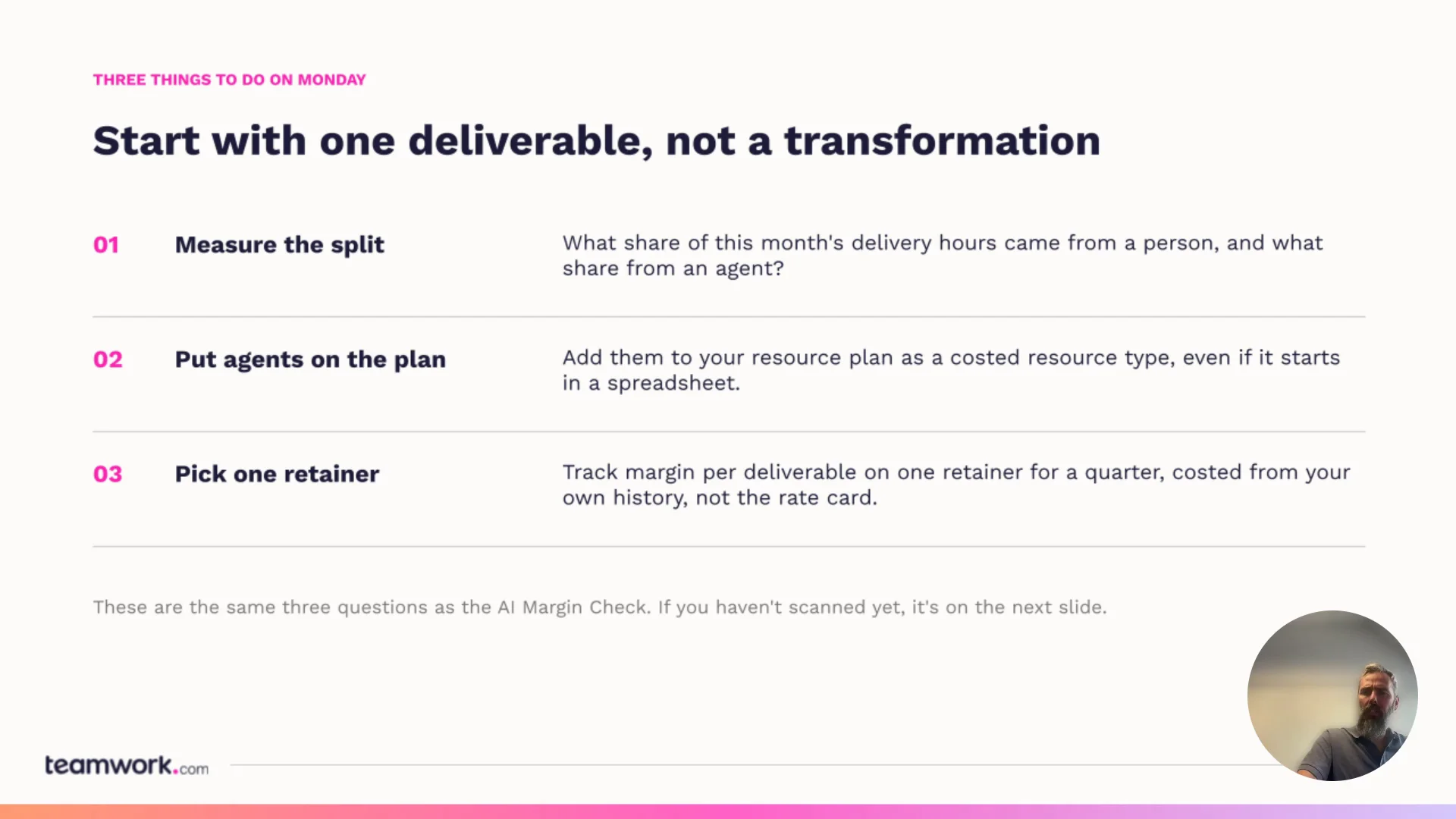
Hello and welcome everybody. Today we are discussing the agency of the future, the agency of twenty twenty seven and how to turn AI savings into margin. So thanks for joining us. We're very excited to share some of our research and best practices on this webinar today. But really what we want to do is tackle the question every services and agency leader is hearing right now. While AI might be making delivery faster, where are the savings that accrue from that going? Are they going into your margin? Are they going to your client? Are they quietly disappearing? So that's the key question that we're looking to tackle here today. We're very much delighted that you can join us for that. As we go through, do please drop your questions into the Q and A on the webinar as we go through this. We'll answer as many live as we can and we are recording so this will obviously be shared afterwards for anyone who's registered for the webinar today. Okay, so on the call today we obviously have my good self. I'm Masi Omani. I'm the chief revenue officer here at Teamwork. I've been here at Teamwork for almost eight years and in that time I've been mostly working with large professional services firms, them actually leverage our PSA technology to help them drive better utilization and margins in their agencies and have worked with hundreds of agencies to do that. And so I'm very much looking forward to sharing how Teamwork can help agencies do that in the AI era. I'm also joined by my colleague Jane Eston who I'll let present herself. Thank you Mosse and hello all thank you so much for taking some time out of your day to join us here today. So as Mosse mentioned I'm head of product here at Teamwork so I get the pleasure of speaking with an awful lot of our customers and actually determining how we build teamwork in order to solve a lot of the problems that Mosse has mentioned now. So I'll get the lovely job later on in the session to actually demonstrate via the product how we do that today for a number of our customers. So delighted to be spending the next bit of time with you all. Excellent. Thanks Jane and thanks for sharing. So first off, we'd actually like to talk with you about the insight that we've gained from the market in how confident are services leaders in their AI margin. So a couple of weeks back, we were at a great event in London organized by agency hackers, aptly titled The Robots Are Coming. And there we asked agency leaders three key questions about AI and its impact on margin. Firstly, can you clearly see what AI costs you to deliver work compared with what people cost you? And quite shockingly, not a single person does or was able to. And that's really quite startling considering how important it is to be able to actually see the impact of AI today. The second question we ask is, in the age of AI, how do you price? And this also really surprised us. 76% are still pricing by the hour, fully alongside some deliverable pricing. Now we've seen a shift from time materials and the billable hour to fixed fee or deliverable based pricing, but we thought it would be higher than this, although we are starting to see this accelerate, but still only 24% priced mostly by deliverables. And then lastly, we asked again, how do you plan for capacity? Can you plan for capacity in terms of your people or with people and AI and agents? And again, quite startlingly, 0% are managing capacity in a fully blended human and AI sense. So that's the ability to actually plan your resources while being able to look at AI agents and humans on the same resource plan. 53% still can plan capacity, thankfully, but that's around people only. So again, that's zero agencies we're actually planning in terms of AI and humans working together. So really overall, it's clear that very few actually have a clear view on how AI is impacting their margins. And that's telling because really today we're starting to see how much AI is starting to impact how clients think about the value you provide and what they should be paying for it. Now this is hot off the presses, right? So it's not just what we're hearing from agency leaders. We conducted a piece of research with SPI Research in The US and SPI has just published their 2026 report on the impact to AI and the numbers. And they're telling a similar story, right? AI now touches 43.6% of projects. A year ago it was closer to 20%, so that's almost doubled in twelve months. And it's working on delivery. Firms using AI on almost every project to deliver, 91% of them on time. Firms that barely use AI are at 76%. Now the really startling thing here is that 85% of you are saying that AI is saving time, but then less than a third are able to save whether it's helping generate revenue. So that's quite striking. AI is really helping deliver stuff faster, but it's not yet making them more profitable. So today is all about how you can close that gap. Now, I've been at a number of events for services firms, for agencies, consulting, large tech, IT services, and the thing that has struck me as we chat about the impact of AI on margin and profitability for services firms is the classic age old problem where sales or your account managers can sell a project with a big fat healthy margin, could be north 40, 50%. The delivery teams are generally pretty happy if they get the project delivered on time and your finance colleagues think their job is done if they can actually make sure that it's billed an invoice in a timely fashion. But almost nobody can tell you if a project is on track or off track from a margin perspective. Nobody is able to tell at the right time mid project whether you're making or losing money. Those insights are still proving hugely elusive for most services firms. So let's have a look at how that leak happens in practice. I'm sure this is an all too familiar pattern for most agencies and services leaders. The client decides, you know, at an early stage in the project to move out a delivery date or move out a go live date and the knock on effect that this has is really damaging financially across the business. The resources that you had stay booked, the utilization drops, your next project starts late as a result, the billing dates move out and the margin is negatively impacted. So the huge challenge is by the time that finance sees the corrosive effect that this has on margins is too late. It's at month end or at the end of the project and people are already planned for other things. Now the killer with all of this is that this was probably fixable at the time. Margin is typically lost in delivery but only reported after the fact. So we see this all the time. The critical juncture is in the middle of the project. So you sold the project at a 35% margin but you find out much to your disappointment that you delivered it with a 19% margin. The estimates were overly optimistic. You had the two senior resources deployed where juniors could have done the work. The scope expanded and you didn't spot it or manage it through change control. And so while the month end numbers may be correct, they just arrived too late to be able to do anything about it. And that is where services firms are losing so much margin. People maybe naively but optimistically thought that AI could help solve a lot of this, right? And the key question is how can AI help with it, right? So the first thing is it can help but only if you look at things differently. While AI makes delivery faster, you have to choose how it impacts upon your margin. So as we've seen earlier, most people are still operating on an earlier time materials basis and really all that's going to do is result in a smaller invoice. If you're actually using AI to accelerate the work and do more of the work, that's less billable hours for you to be able to pass on to the client and that is the path to ever shrinking margins. So the definition of insanity and all that and continuing to do the same thing. So you can see here if you actually just stay mostly on a time materialism basis, you're looking at the prospect of your margins starting to disappear. Now the great thing is AI gives you optionality and in business most of the time what we're looking for is optionality to give us growth. So every option starts in the same place. The critical thing is knowing what the work is going to cost you and how AI can help with it. So if you're genuinely using AI to help deliver the work faster and cheaper, then you can sell the same work but with a much healthier margin and maintain that margin during the project. So that's one option. The second is if you're able to actually see the costs of using AI agent and to plan with those in mind, you can choose to sell work with a lower margin to win more work and to win work that your competitors just can't take on. So that gives you another option and a competitive advantage in the marketplace. These are the ways that we're seeing that AI can help agencies survive and thrive in the AI era. So what's required to be able to actually plan and deliver work this way? Well, the first thing is your utilization dashboard is about to make a fool out of you, right? And the problem is we've relied so long on utilization as one of the key drivers in an agency that now it's starting to lie to us. And the cruel irony in all of that is that we like to call this the denominator problem. If agents actually start to take on a lot of the low end repeatable work, the people in your agency who are most AI forward are going to start to look like your worst utilized and your worst performers. So if your teams who are most AI forward use it most effectively, it's going to negatively impact their utilization. So we're not saying utilization is dead, but on its own it is about to tell you the wrong story. The second challenge this creates is that if AI does free up a lot of your people's time, you have to figure out how to use it productively. Free capacity is only worth it if you can fill it with productive or profitable work. So you got to either sell more work or find productive uses for your people's free time. So that's a resourcing decision before a pricing one, you need to be aware of the impact this has. The third one is that the typical pyramid from a skills or resources perspective that agencies have used for forevermore is starting to actually erode, right? You're actually going to end up with more of a diamond structure. If agents do the work of juniors, how are your juniors going to become tomorrow's seniors? Where do they learn their craft? How do they learn to do the key work along the way? How do they learn that experience and judgment required to be really good contributors in your agency business? And so I'm not sure anyone else has quite cracked this yet or I've heard a convincing answer to how to address the Pyramid Diamond Conundrum. So this is what we mean when we talk about the widening layer, that cryptic title that we spoke about earlier. Agents are only useful if you can start to actually plan them as capacity. You need a way to be able to see that they're actually part of your resource plan. And that requires a couple of key things, right? The layer of work that agents take on only widens when firstly you can clearly see what work they can do. Secondly, you need to be able to see what the relative costs of the agent doing the work versus the human work. And then lastly, it needs the governance layer. It has to be supervised Unless the resource and operations and delivery people can trust that the AI is doing the work effectively, then it's going to be very hard to actually deliver the work relying on the agents. You need the human in the loop and you need the human in the loop supervising iteratively with the agents to ensure the quality of the work that they're delivering gets better as they go. Now, we believe that if you put these three key things in place, then that's going to widen the layer of work that agents can take on. And the unit of planning will shift from the billable hour to the deliverable or the outcome. Now this doesn't come for free, right? You can expect a kind of nasty looking J curve in the early months that you do this. Margin may dip in the short term while you actually build out the infrastructure and instrumentation for doing this. But that dip is not a failure. It's the investment in the future. It's what's giving you the system in order to leverage agents to deliver work with greater margins. So the way we like to think about this sort of mental model that we use is what work can humans do and what work can agents safely do, right? And to do that, you need to be able to actually assess the nature of the work or the jobs that agents could take on, right? The more repeatable, structured, or high frequency the work is, the more suitable it is to an AI agent to be able to safely deliver it. So if you look here in this quadrant, so top left we have the judgment layer, review and sign off, storytelling, client strategy. They're the classic high value things that your people do today. It'll be a long time before agents can really take that on. The bottom left is work that still needs to be delivered by humans but can be greatly assisted by agents. So that's pitching for new business. The selling will still have to be led by your people, but the prep and the research required to do the selling can be assisted by AI. Workshops and facilitation. There's a lot of prep research work goes into those. They still have to be delivered by humans. And ultimately in a relationship business, your people still have to be the ones managing the relationships, but they can be assisted by AI. If you look on the right hand side, we believe there's a world where native agents and agents that are almost like blueprints or templates can massively assist in the acceleration of the delivery of work and the improvement of the margin. So for example, on a platform like Teamwork, we believe there should be certain types of agents that make sense on a PSA or agency solution. That can be client reporting. It can be proposals and pricing. It can be QA. It can be research or production synthesis. Equally, we think that it's going to be critically important to be able to integrate or have some kind of a harness for all the other agents that you have in your business. What we're starting to see emerge from the research now is that the best agents are often the ones developed by the domain experts on the front line. So your people will use agents from other systems or ones you develop in house yourself. You need a system that can plug in to those agents to understand how they're working, what they cost, and what work they can take on. So if you can see all of your agents and your people together in a framework like this, that gives you the system and the leverage to be able to plan with agents and humans in mind to improve your margins. So what might this look like in practice? Well, here's a simple example of how a retainer can be delivered by both humans and people and run on a regular monthly basis. So things like the rankings and the analytics, well that's ideally suited to an agent being able to do that. The technical crawl and the triage, again an SEO agent could do that. The content drafting, that can be done by agents initially but approved by a human strategist. The client reports and insights, similarly can be done and drafted by an agent but delivered by the account lead. But ultimately the strategy call and plan, that has to be human led. But in a scenario like this, can see here that almost half the work or maybe even more than half of it can be taken on by an agent working closely with a human. That means the fee holds if it's on a fixed fee basis, the delivery call can fall dramatically, and you can use this across lots of different clients, ultimately contributing to significantly higher margins. We're so excited about this. We actually believe this could be the biggest margin lever in decades, right? If you look at this, these are indicative figures, right? In a typical agency or services business with an operating margin of maybe around 15%, almost two thirds of your cost is typically staffing costs, and up to a third of that is often the junior work on that payroll. We believe that almost a third of that work could be taken on by agents in most large agencies. So the potential savings here are in the hundreds of thousands, if not millions, for a lot of large agencies. You could see an almost 33% improvement in your business level margin. So the real prize here is choice, right? Once you know how to actually use agents and humans together and how to cost it, you can decide where that gain goes. You can bank it and keep the margin or you can compete on price to win more work. But you get the choice. You decide, not your timesheets. In terms of how you could actually practically apply this, I'd like to leave you with three takeaways and then tell you a bit about how you can do this in practice. The first is just pick one area or deliverable where you think you could apply this easily and safely in practice, right? Measure the split, right? How much of the work can be taken on by an agent and then how much remains for you humans? Figure out how you can wrap your agents as part of your capacity plan. Put them on the plan, if it's just in a spreadsheet, and then pick one project or one client where you think you could safely apply this and track the margin where the agents and humans delivered work together and see what impact that has on the margin. I think if you you pick these three things and just have the courage to go over and try them, you'll be really pleased with the results. Now we here at Teamwork like to think that this is already possible with our platform and to show you how I'd like to ask Jane to give you share an insight of how this can be done in practice. Perfect, thank you so much Mosse. So Mosse has spent some time you know telling us that AI is saving agencies time but that's really not translating into money because margin is lost during the delivery and as Mosse has explained is only evident or comes to light at month end or at the end of the delivery. So fixing that really starts with knowing what the work actually costs up front and optimizing the delivery plan around that. So I want to show you today what that looks like in teamwork.com. So you're going to see margin optimization at a number of different points during the delivery cycle throughout this demo at the point of quoting, point of resourcing for an optimal resourcing mix to really push that margin return and you're also going to actually see how that AI quadrant that Mosse spoke to could work in practice. So AI working alongside you to improve not just the operational efficiencies in some of those resource planning scenarios but actually resulting in real margin improvement by leveraging AI to help deliver the work more profitably. So for the sake of today's demo I'm going to step through an engagement that we have with Halcyon Logistics. So Halcyon Logistics is a client of ours and we want to kick off a new fixed fee digital transformation project. We know that this always starts with a quote, so I'm going to jump straight into the quoting area. I can see that I have a number of open quotes, some expired quotes, but the enterprise AI rollout is the the project that we really want to get planning. So I'm going to jump straight in there. The first call out here is that you're going to see AI actually stepping in and making initial recommendations at the very outset. So we can see straight off the bat based on the existing quote and plan that I have, there's some recommendations that our AI agent is making to improve the margin. So these will include things like the actual resourcing mix. So we can see, for example, that we have a senior consultant that's available that can take on the ROI business case in place of a more senior costly resource. We can take that partner off the work and replace it with a senior consultant. Similarly, it's actually identified that we have historically delivered upon a transformation roadmap and we actually have the opportunity to improve our pricing and to improve margin here. By accepting both of these recommendations, I'm going to be able to improve the margin that I make directly from the outset within the quoting stage. So in this scenario, we'll go ahead and we're going to accept the pricing changes that have been recommended. And then we're also going to separately accept the senior consultant building the ROI business case. So straight off the bat we have a better margin return on the quote that we've built. We know that within this engagement there's a number of different phases that we need to deliver. Can see first there's the readiness and discovery phase, the road map and business case, etcetera. Within each of those phases we have discrete line items. Within each of those line items we can see who exactly we need to do the work. So for example for the stakeholder and interview and workshop synthesis, We have a senior consultant. It's going to take roughly forty hours and I get all of the detail needed around the cost rates, the total cost amounts, the billable rates, then ultimately the potential profit for that line item. And then of course you get a holistic totaled view for each delivery phase as well. Similarly at the top of the quote you get that full rolled up view and we can see straight away here that we have an margin of about 3536% for this AI digital transformation. We know that this quote is ready to go so in this scenario we're going to immediately convert it to a project. What's really important here is that we've done all the upfront work, we've built out the quotes, we know who we need to do the work and we know when the work needs to take place. All of this is going to automatically be translated into a project. There's no need to come in and rewrite the project plan, this can all be directly inherited from the quote. Similarly with the budget and financial information we can see that it's automatically selected a fixed fee budget for us, we can see the total fixed fee amount, we know the start and the end date and we can keep an eye on our financial targets here as well. So I'm going to jump in and I am going to create and then open this project. So a couple of things that I wanted to step through here before we jump into the actual plan. At teamwork.com we know that there's a number of different areas that AI can support with. We've spoken through some of them already but one of the most valuable implementations of AI that we have in the product is with our Ask AI feature. So Ask AI is a co pilot type agent or AI assistive interface that will follow you around the product and has contextual awareness So I can really quickly and easily get an overview of information within the page. So in this scenario, maybe I want to understand based on the current project plan and resource plan that I have for the enterprise AI rollout, what's my planned margin on this project? And it's gonna come back and give me all of the detail that I need. You'll see in here as well it's actually making some recommendations based on the observations that it's made on the data within this project. If you find that you are kind of repeating a number of different asks within Ask AI there's something that on a daily or a morning basis you actually want to be able to come in and prompt. You also have the ability to save these as AI skills. So for example you can see here the likes of log my time creating a task from notes. You also can create a custom skill So if it was a weekly capacity digest that I wanted to look at, I can create a repeatable skill that will then be saved within my ask AI and very easily and readily accessible whenever I need it. So that's just one of the ways that we layer AI into different areas of the product. As I mentioned at the top for both internal operational efficiency, as well as optimizing the margins as Mosse would have spoken about. If we jump into the project plan here we can just step through and see what we're dealing with. So within this schedule I can see an overview of all of the resources that I currently have planned within this project and I can see the work that they have been assigned. So for example for Tom here who is a senior consultant, I can see that he has about four hours of work per day this week because he's going to be focusing on our stakeholder interview synthesis. I have the ability to jump in very quickly and easily see what's the billable rate, what's the forecasted cost and revenue for this resource and a bit of a breakdown in terms of what that allocation or task is for Tom. I can also see if I scroll down here that we have Sam Delaney who's a junior consultant. Sam is over capacity, the work that we've given him is pushing him over his eight hours availability for the day as a result of this AI readiness assessment task. The last resource that I want to draw attention to is our junior consultant agent. And the reason that this is super important is because it speaks to a lot of what Mosse has spoken a bit already. So we can see in this scenario, we have a custom agent that we've built. We've built it with a number of skills, that's associated with that agent, and we actually have the ability to resource that agent alongside our human resources. So we can see that the junior consultant agent actually sits on our resource plan and has capacity, has a cost rate, has billable rate, and has availability to take work. So we can see in this scenario Remy, who is our resource management assistant, has actually observed three recommendations for this project that's help... Going to help us improve margin. So I'm going to jump in and see exactly what it is that Remy has identified in terms of optimizations. So we can see that there's three recommendations that have been made and the first is very much around the margin side of things and what Remi is actually recommending in this scenario is that we actually hand that AI readiness assessment work from Sam who is already over capacity right now to the junior consultant agent. So Remy knows that based on historic work that we've completed similar to this AI readiness assessment that our junior consultant agent has the skill sets and the capability needed actually deliver that work. What's really important here is that she is recommending that you keep some of Tom who is our senior consultant some of his time to come in and review and actually make sure that what the junior consultant agent has produced is corrected to a standard that we're comfortable with. By accepting this recommendation, we can see that we'll actually improve our margin by about 9% on this engagement and will give us a return of just over $13,500 in terms of reduced costs. So that's the the first recommendation. The second is actually around seniority mix. So again Remy has observed that we have Tom who is our senior consultant, booked for sixty hours of documentation and data prep. Now based on historical work, again historic project and client work that we've delivered, we know that this is the type of work that can be delivered at a junior level. So what's actually being recommended here is that we move forty eight hours to Sam who we know is now free because the junior consultant agent has stepped in and taken Sam's workload in the previous step and we'll keep about twelve hours of Tom's time for review. Again the result there is we get $2,880 back in terms of costs for our resources increasing the margin by about two percent and we also know that Tom is now freed up for an upcoming meridian pitch that we're working on for tentative work that the sales team is working to close. The third recommendation is around billable utilization and capacity. What's been observed here is that we currently have a resource that's on the bench so that's Priya who has eighty hours of unassigned time within the time period that we need to deliver a particular piece of work. The original plan was to actually bring in a third contractor via Databridge, which was going to cost us about a $120 an hour. By making this switch and actually pulling Pria off the bench and no longer going with a third party contractor, we save about $4,600 in terms of cost and we actually boost our billable utilization from 71% to 78%. So these are the types of recommendations that Remy the resource management agent is actually able to observe and bring to your attention. So in this scenario we'll go ahead and proceed with handing off the AI readiness assessment to the junior consultant. One thing that's very important to call out here is that you actually get the opportunity at this step to go in and really interrogate and understand the rationale behind this decision. So why the junior consultant agent? Why is that the agent or the resource that was proposed? If we make this change what happens to Sam's two hundred hours? We know the importance of being able to really understand the rationale and the reasoning behind these types recommendations to really build that trust with the recommendations that the agents are making. Again we can see here that there is kind of a before and after view so we can see the current plan, the cost and the margin and then also the impact where we go ahead with the recommendation in terms of moving from the junior consultant agent and also using some of that senior consultant's time, the cost savings and the margin make that we have there as well. So I'm going to go ahead and approve this suggestion and we can see straight away that that has now taken effect within this project plan. So we can see that Tom is now working on the AI readiness assessment review, so that human in the loop senior consultant assessment of the work. But then we also have that full task has been taken off Sam and is now assigned to our junior consultant agent. So at this juncture, I'm going to jump in and actually look at that task. So we're in the enterprise AI rollout project, and we can see that our junior consultant is now the assignee for the AI readiness assessment. It has all of the detail that it needs here in terms of the description. We can see that there's actually four discrete sub tasks that need to be completed in order to deliver this full task and if we scroll down we can see that the junior consultant has actually acknowledged that it has now picked up this work, it's been assigned to it, but it's letting me know as the project manager that it actually needs a little bit more information and it needs a little bit more source material in order to actually deliver this task to as high a quality as it can. So I'm going to come in and I'm going to give it that context that it needs. There's a number of files that I'm yet to attach to the task and this will round out all of the context that the agent needs. What we can now see because the agent has all the context and information that it needs to kick this off, it's actually beginning to work through those subtasks. The other really important call out here is that we can actually see that it's logging time against the tasks based on the estimated time that we had already initially planned out. So we're able to really clearly see the deliverables and the discrete kind of tactical steps that the agent has completed, but also we can see that it's logged time against the estimated time that we'd actually planned out for this deliverable. I'm going to scroll down and I can see that the junior consultant has now drafted up the AI assessment or the AI readiness assessment, But what it's doing at this point is it's looping in Tom, that senior consultant that we had assigned as that human in the loop review step. It's letting him know that got about 86% coverage and I'm pretty high confidence in five of the seven dimensions, but I need for you to come in and check this out before we share it with a client. So at this point, Tom has the ability to jump in, review the the assets that the agent has completed based on all of the inputs that we've given us. And again, really important stage of being able to understand the content of the the data, but also make changes on the fly. So for example, there's a draft AUP here. So Tom actually knows that instead of the governance and risk being a one out of five, it should be a two out of five. We can let it know that it needs to update it and give it the reason why. Similarly we can actually go in and say you've you know scored the process readiness as low confidence what's the reason for that and it will come back and give us the rationale. So at this point in time we're happy with the assessment, we're ready to share it with the client, we can approve and this can now be sent to the client for review. In the background we can see that that final task that the agent has checked off has actually completed phase one of the project. So we can see the readiness and discovery phases completed with all of those tasks checked off in the background. We've automatically created an invoice because we know that we have a billing milestone once the the first phase of this project has been completed. This is a $30,000 invoice that we need to spin up here. That's automatically created and I can jump in and look at all of the detail within the invoice. At this point, as the account manager or project manager or ops lead within this account I actually want to understand the margin that we're now sitting at within this project. We've delivered phase one but to Massey's point a little bit earlier in the session it's really important to keep an eye on how margin is tracking at this stage rather than waiting until the engagement is fully complete and then learning the margin that we've actually come out with. So again I can leverage Ask AI and I can actually view an AI margin report. How are we performing as a result of leveraging AI within this project so far? And you get the full breakdown of the agent revenue versus the agent cost, what's the margin that we've actually kept and what's actually the margin on the work that the agent has delivered versus the initial resources that we had assigned to it. So you get a really detailed understanding of the planned versus actual as a result of all of these recommendations that AI have made within the product. And then at that point, it's super easy to actually save this as something that I want to come back and check-in on both within this project, within different projects for this client and across different client engagements as well. So again with a single click that report that the agent has spun up, I'm able to actually save that in the reporting area of the product and use it as something that I can come back to over and over again. So that's an overview of the ways that teamwork.com can help you catch that margin leakage during the delivery of the project while also planning as effectively upfront and making those replanning and scenario based decisions as you make your way through the client engagement as well. Thanks for that, Jane. Earlier in the talk, you saw how AI can have a transformative effect on margin. Well, now you can see that's easily possible leveraging teamwork today. So as we've been working through that, there's a couple of great questions that come in here. So the first question we've received is clients are already asking why a retainer hasn't come down if you're using AI. How do we answer that? Well, it's interesting. At the robot summit I was at a couple of weeks ago, this came up actually quite frequently. And the general wisdom of the room was that actually if you can defend the value of what you're providing to the client and you're doing so on a fixed fee basis, then really the client shouldn't be overly concerned as to whether you're using AI or not to deliver this. The ultimate or most important thing is actually that you're delivering what you said you would and providing the value that was promised. And if you're doing that, then really the client shouldn't be overly concerned about whether you're using AI or not to help accelerate the delivery of that value. The second question that's come in here is what have you seen happen when clients find out a firm is using AI? Are they asking for discounts? So again, this is something we've heard in agency circles quite frequently and this is happening, right? I think particularly when it's very visible to the client how the work is being delivered or they're very sensitive. They are asking whether AI is being used to deliver it. And I think ultimately, again, this boils back to the same core rationale as that of what is the value that you're providing to your client and how defensible is that value? If the way you're providing that value, if the value is really clear, then ultimately the price you command for that should be defensible. Now, if you want, as you've seen there what Jane presented, there is a way of actually showing how the work is cost and delivered by AI with a system like Teamwork. And if you agree an approach with your client for how much you're going to charge for what humans do and what AI does, then ultimately that's a pricing or a commercial decision for your agency. Teamwork is great because it gives you that visibility and then ultimately you have to agree with the client how the pricing is effective if it's being delivered by AI. But the key step actually first and foremost is to understand what the AI is costing you and contributing to how you're delivering the project and ultimately the margin on that project. So look that's all the key questions that we have time for today. So we'd like to thank you very much for participating today and sitting in with us And if you'd like to find out more about how to leverage AI to improve your margins with humans and agents, do please check it out on teamwork.
The Agency of 2027: Turning AI Savings Into Margin
Speakers

Mossy O’Mahony
Chief Revenue Officer, Teamwork.com

Jane Aston
Head of Product, Teamwork.com

Professional Services in 2027: When AI Joins the Team

Product Roadmap Webinar Q3 2026

Work smarter with TeamworkAI

Product Roadmap Webinar Q2 2026

How to prove value and defend your fees

Building the Foundations for Modern Resource Management

Product Roadmap Webinar Q1 2026

How To Talk AI With Clients (& Boost Profits)

Product Roadmap Webinar Q4 2025

Desk 101: From Chaos to Clarity