It’s About Time – Changing Your Agency’s Relationship with Time
Transcript for the video 'It’s About Time – Changing Your Agency’s Relationship with Time':
All right. Welcome, everybody. I'm Logan Lyons, head of partnerships here at teamwork. Thank you for joining us in another one of our monthly webinar series here for agencies, it's about time. That's actually the title of this one today. A little tongue in cheek. I have with me our guest today, Nicole Pereira. She's a remote culture advisor at culture. She is a veteran agency owner herself. Nicole, welcome. Thank you so much for joining me. Glad we're recording this conversation of the many. You and I have. I know we joke often that every time we're chatting we should record it. So here we are. We're inviting everyone to come and be in Nicole chat about time, which is pretty much what we always chat about, right? Yeah, absolutely. Absolutely for those of you joining us live, this will be recorded. There will be a copy of the deck going out. I know that's a question everybody asked, not in just this series, but webinars in general. So we'll get that housekeeping out of the way. I'll share a little bit of an agenda. You know, in agency life, things like time tracking, time management, our utilization rates, those are things that are important to client service work. And I'm excited to share with you a little bit of Nicole's journey today and leveling up that conversation to some questions and some things that we often don't think about before we dive into my team's not tracking their time. How do we align her? We talk with customers and our team about time. But before we get into that, Nicole, give people just a little bit of context who aren't already following you. You've got probably double the followers I have on LinkedIn, so a lot of people attending probably do already know you, but in case they don't give us a little bit of context before we jump into the agenda. Yeah there seems to be some people who haven't gotten tired of me, so I'm always suppressing. I'm included in that. So it's all good. They've just forgot how to like, remove me on LinkedIn. But I have owned two agencies so far. I've owned several, several business over several decades, consulted in marketing. So have sort of been a part of all the whole life cycle of what it means to deliver services. And so I have a new consultancy culture that's sort of here to help me advise those who are looking to do similar things that I did. I built a little bit of a reputation around like agency culture and started building that reputation back when agency life was like the worst thing, like that hashtag agency life implied everything wrong with agencies. And so I'm hoping that I'm just infusing a little bit of rightness into that. And one of the big ones is usually, you know, it's like high stress, low pay and doing everything for your clients at their whim. Right I can't control doing everything for your clients if there when that's your choice. I also can't really control what you pay people. But what I can do is inspire you maybe to fix the time part, and that could lower stress and a lot of other things. And I think with just the climate that we're in today, a time generous way of thinking, if you are either the owner of an agency or in a position of power for a small team in an agency, if you can reframe how you're delivering time and thinking about time and your organization, not just how you deliver it to your clients, but like the organizational design of your company, then you're going to find that you're going to be able to compete. So much better in this new remote post-covid world. I love that. And what I just want to reiterate to folks who are on here and your perspective and your expertise, there are a lot of folks who are consultants and advisors to two agencies, and some people kind of poke fun at that place of telling you what to do with your agency. We were just talking about how David Baker's podcast is called two Bobs and kind of the tongue in cheek reference to office space, those sorts of things. What I love about what you're doing, Nicole, is that you've started this consultancy culture ish to help agencies, and you're doing that. You're doing things like leading our teamwork user group to help agencies who happen to also be team work users. You're still running your agency. And so it's not like, you know, the salesperson who's sales trainer who comes in is like, OK, when was the last time you carried a bag? So everything that you're sharing, we're going to step back in your journey and cover three years of learnings and tell that story and how it changed the way that you think about time and advise other agencies to think about and talk about time, not only with their clients, but with their team. But I just want to reiterate to people, it comes from talking to other agencies, but also still running your own. So a few other things for folks today. You can use the questions box to put in a question for Nicole and I, as we go throughout the conversation, we might quick take a quick timeout and I might pose that Nicole as we go or hold it till the end. We'll see. But we'll definitely try and answer as many questions as we can as we go a little bit of what to expect. We're going to start with, as we mentioned, Nicole's journey as an agency owner herself and what she realized in how we need to think about time differently. That will actually help us talk about time, track time, manage it within our agencies. And there's really three components to that is where we work. When we work and how much we work. We'll talk a little bit about remote ish is the agency that she still runs and operates and then what that means for you and some time for Q&A at the end. So with that, Nicole, let's talk a little bit about the story I've heard from you before. I think it was 2018 and you really started to think about your own time and work differently. That actually pushed you into starting an agency. That was really the start of the journey. So take us back there. Yeah so it's interesting because. As an agency owner. I haven't forgotten, though, what it is to be an employee. I look at the framework of what I built in my own agency and how I have to operate in it. And if it doesn't work for me, it sure as heck is not going to work for anyone else. If I'm not loving it, then no one else is going to love it. I'm also a person who firmly believes that if I'm being afforded certain freedoms, everyone should be afforded similar freedoms. Right? I went to business for financial freedom, for time, freedom, for creative freedom, all these things. And I want everyone who's there with me to experience that, because if I'm insanely happy at the expense of the people who work for me and/or vice versa, I think a lot of business owners become the victim, right, of the people who work for them. If they allow it to happen. And so this is me just trying to make sure I'm aligned, that I'm building an environment that I would thrive in. And if I'm thriving, then I know that others will be thriving, too. And so I always check myself. And so I'm going to share a little story, the 2018 story that we talked about. I wrote it down because there's some numbers and calculations. So if I sound like I'm reading, I really am. But that's how I can stay on pace here. But when I left my last agency, it was a very office culture agency. I had some business partners and there, there, you know, voice was a little louder than mine. They truly believed being in the office, like many people do even to today, that being in the office is the only way to deliver agency work, which I think is a little ridiculous in my opinion. And I will say that matter of fact, because I don't criticize too many people, but like your clients are remote and you collaborate with them just fine. So think about that for a moment, but let's start with where. So I feel like where of time autonomy, right? How we're managing our time, how reviewing time is the foundation? You have to figure out that first, like where do we work? And I think a lot of people go, well, that's simple. Or you're either in office or remote. There's like two options. That's all you got. But I want to walk you through this little story of maybe my encouragement for you to consider remote. And then we're going to talk about remote as a spectrum, like not just one or the other, but one and many other options and everything along the way. Right? Yeah. So here's the story. In 2018, I worked on office. Each morning I would wake up and get ready for my day. I would spend 20 minutes to get dressed, 15 minutes for breakfast, 10 minutes to organize my items and get in the car. So before I have even left my house, I've spent 45 minutes of an investment that I'm making in this job because I'm not really getting anything for it other than retaining my job at the shop. And then we're going to tally this as we go. So if you're good with math, if you just take these notes, so at this point now I'm ready to go to work, you know, so maybe today was a good day. Maybe I got all green lights along the way, no traffic. Maybe it only took me 20 minutes to get to work. You know, from my garage to, like, the parking lot of. Of the office. I took 10 minutes to walk to the building and get to my desk and all in. That's another 30 minutes. I just try to. And that's why in this clock forward, I had a productive day. Let's say it was a good day. No complaints. But then I have to come home. At the end of the day, maybe I'm having 45 minutes of traffic. So so let's, like, calculate all this, like, and I haven't even figured out what it means to get home and get, like, situated at home. But let's assume that the moment I arrive at my garage. Right, I'm done. I can call it good there. So you had 45 minutes early, 30 minutes in the middle of the day, 45 at the end. So let's see. That's hour and a half. Another half hour, that's two hours. Am I doing that right? Hours, Yeah. So every day, every working day, I spent two hours of uncompensated time just to have a job. I owned the company and yet I still sort of like this is like this was like dead time. Like, if you work, I don't know, say you work 10 hours or so. You work 52 weeks a year. If that's 10 hours a week, I assume there's no vacations agency life, right. That's that's like over 500 hours of uncompensated time just to be employed like this, this time not giving any value to anyone, anywhere. Like, like it's a draining time without, like, a giving time. There's no money coming from it. There's no production coming from it. And so when I left my last agency, I was like, there's got to be a better way. Like spending all this time just to do work doesn't make any sense. And I always felt like I was pretty productive when I was working at home on the weekends because I owned the agency. I worked a lot more than just in the office and I said, nope, this, this is not going to happen more. Like my new way is going to be remote. I'm going to figure it out. I knew how to work remote myself, but as I started hiring other people, I had to figure out how we all could be remote. And so when I started the agency, I switched from consulting to the agency in 2019 and started hiring people. We spent the whole year to figure out like, what does this remote mean? Like because it was so front and center that you named the agency remote ish. It's like an ode to our passionate way of working back then. And for context for folks, you know, 20 seconds on remote ish, you know, what sort of agency you guys are in the HubSpot ecosystem, just for context. They're in a cool, super small, super boutique HubSpot wrap ops agency. There's like 12 of us. Like, we're real tiny. We've we've expanded. We've shrunk that. We've always enjoyed being a small, little intimate crew. It's also lended our ourselves to be able to do some really aggressive, like experimentation, like Coke, but like company culture experimentation because we're small enough to tolerate it. Right and and that's where we're at today, right? It's the results of multiple years of really aggressive testing, of certain things in year one being remote. And I'll share with you, you know, when we first started, we were all remote, so we were all in the same city I hired in the same city. In my mind, I still felt like we had to get together. I still had a little bit of that legacy mindset, like, we do need to get together once a month for an event. Like we won't be connected if we don't do that and we had fun. But then when we had one employee who wanted to move to another state. Basically give me her resignation. I was like, no, no, no. Then I was like, let's figure this out. I never thought about it. I never considered it before. But the moment that I no longer wanted to lose someone, I was like, OK, well, now I'm willing to learn what it looks like to have someone in a different state. And we have a side that we could share with the spectrum. Yes, absolutely. We're on the same page, which is why I ended up starting to talk over you. My apologies there, Nicole. So that really leads in to what I've heard you talk about. We mentioned at the onset, like before you really start to drill in and talk about time with your clients and your employees and how that is structured, how you track it, all that sort of stuff. You need to figure out these three things about time where we work, when we work, and how much we work. And you think that to your point with where I have a very similar story 2018 I went remote from do in and kind of an old school industry where it's local B2B sales. You got to be, you know, in your seat at 8:00 in your seat until five. A lot of presenteeism in that case. And I was feeling the same things as you have. Like there's a lot of wasted time, there's a lot of unproductive time. It's not necessarily great for the employee and the employer. I think a lot of us, whether you're like Nicole and I, and you recognize that a little bit pre-covid, you definitely started to realize it because everybody was forced to consider where in 2020. Right but I think what you mentioned there, Nicole, is the question of where isn't just in-office or remote. And everybody you'll see as we go the questions of where, when and how much there's a spectrum on all of them. And what I've heard Nicole say is there's not one right spot on the spectrum. I mean, Nicole, you've got a pretty strong opinion on always in the office, maybe isn't the best. But even there the question that was in your employees mind who said we're remote, but we're all in the same city, so if I leave the state, I need to resign. And that was basically the two of you needing to come together and look at, well, where is remote ish on this spectrum? Is that OK? So tell us a little bit about this spectrum and then how you started to walk through it at remote ish? Yep and this is not all encompassing. It's not like every possibility on the planet. But I tried to get pretty thorough, try to really think of like all the people I talked to, all the different scenarios that I see. You'll be surprised that if you jump from one to 2, so always at a fixed location, employers choice. That's basically in office, right? Like you're always in one place with employer chooses, but there's another fixed location option. I didn't even think about that till my spouse was put into that situation. He was able to get a remote job, but because he worked in a health care field, the IP locked him to our home. So he felt like he was kind of like though he got that two hours back. So that's so immediately moving from like level one to level two is like you're basically gifting time back to the person, you're gifting less burnout or you're probably going to get more productivity from them because you're not competing for this 2 hours, which is a huge chunk of time in the day. But you if you require them to be IP locked, they're just basically a relocated office worker. But it's still better than being in an office if that doesn't work for your culture or for the people that are there. Right and plenty of people like hybrid options. And I haven't even dived into hybrid because I feel like hybrid could be woven into almost any one of these situations as you go down the list. Right it's like driving distance from a fixed location. So we were all in San Diego when we first started the agency. We were all driving distance. It didn't really matter where you lived in San Diego. Honestly, one of our gals lived in Orange County and would just drive down once a month. And so as long as it was like and you and I were chatting, we were like, well, well, technically couldn't, you know, couldn't I live in florida? As long as I'm willing to pay the plane ticket to come once a month. Could be if that was on, you know, where you're at on the spectrum of which the next one is, you know, maybe it's not really the fact that they have to be driving distance because they're not showing up tomorrow at last minute notice like that could in theory be anywhere potentially in your state, if that's the only state you do business in, which is your could be your choice or your financial choice of how you are going to be. It's not raw. You land here might not just be about culture. It might be about, you know, the legal and financial implications for how the business is set up. You're not set up to pay people in other states or, you know, different things like that. And so I think it's layered here, and I love this framework of the spectrum on each of these, because it identifies that where we work isn't a Yes or no. It's a spectrum. And then there are layers to determine where you're at on the spectrum and letting your people know where you're at so that you can build the culture accordingly. So I'll let you keep going here because this is great fun. And let's talk about 2019 right at the end. And we're transitioning into 2020 COVID era and everyone went remote, but it was a disaster because no one knew where they felt like everyone's definition of remote was different. Somebody is like, oh, I'm going remote, but I'm still having to work from 9 to 5. I still have to have my cameras on. I still have to go to the office twice a week, so you just have to define it. I think clear is kind is a really great phrase out there. And if you're not just super clear, I think what annoys people the most. So let's go to the next one. Must be a resident of your state or must be a resident place country people see like remote. And then you're like Denver, Colorado, right? Like, wait a second. Like, so I'm allowed to be remote, but I have to be in one state. Like, that's not really remote. You know, that's not remote as I define it. And then you have to take it to bigger extremes. Right I know HubSpot is launched a program, which is pretty enviable, where you could be, I think, in a different country up to four months out of the year. So you going to be like this digital nomad? And I think it follows some compliance rules or whatnot. And then you go to the very, very bottom, like the most extreme cases, like live anywhere, any time, like move around. We don't care. You know, like we'd love to see your backgrounds if you're on a visa today and, you know, Nepal tomorrow. So I think you just have to figure out what that is. There's also the possibility. So my agency has W2 us based people and then we have sort of like contractor like non USB based people. And so they have slightly different rules of what is possible for them because of the classification. But we're OK with it because it's clear everybody understands how it works. And as we go on to when and how much, as long as they're OK with when and how much, you know, being sort of universal for everyone, then where it could be where people diverge. There's not to say that your when and how much can also be different for different people. But if you don't articulate that, if you don't document that, you don't communicate that well to people, it's going to be a bit of a disaster. When someone comes and works with you with an expectation that's totally different than what you're trying to convey. Yeah, absolutely. And what you mentioned there, I've even seen that where someone was kind of railing against a job posting about, hey, this says remote, but it says Denver, Colorado. Like, that's not remote. Well, it can be. It can be, you know, somewhere on this spectrum of where but as we mentioned, how do we define that? So I think I don't think the issue is work anywhere, any time. We don't care if you switch countries every week is the only way to truly be remote. That's one spot on the spectrum of where we work. What we talked about is remote, but in this city is another place. The important thing is to define that for your agency. Be clear with your employees. And then everybody is on the same page. So we will look next when and how much, because all of this does roll up into how you manage time within the agency. So not just are you remote or not and what sort of remote, but then it leads into when we work. Because before you get to, hey, this is how we track time. And this is what we expect. We've got to have a conversation about when we actually do work for clients, right? And so you see a similar spectrum with when we work and then we'll get to how much so. Talk to us a little bit about that transition from thinking about where to thinking about when to call. Yep so I'll, I'll keep using sort of like milestones I think we've all experienced. So when, when COVID hit and flexibility became this big term, we had already figured out the remote part, but then everyone was like, well, I'm now I'm remote at home, my kids are here, they're home. Like, it's difficult. I need some flexibility. What is what does that mean? And the reason why no one can agree on flexibility, because it also is on a spectrum. There's not just like this one definition of what that flexibility can give you. There's more or there's less flexibility. And so when we were sort of nailing it on the proximity side, right, where or how remote or less remote we were in 2019 and 2020, we needed to figure out flexibility because we still largely worked from like 9 to 5. It's just we were all in the same time zone. We all just sort of, you know, our day job and the internet lives and whatever. I think I was more of an extreme case that really worked off the rails at weird times, but largely my team wanted more structure. And so that was fine. But then they needed flexibility, like requesting time off and all this stuff was like, not something I wanted to do. And I was like, these are grown adults. If I can give them a framework, we should be able to figure this out. And the press for covid, you know, like of pushing that and seeing the struggles with my team of having to take care of kids, having to stop everything in the middle of the day. I was OK with it. I just needed to define where what I'm willing to tolerate and just put the boundaries around when and make sure that flexibility is clear and understood at the agency. And so we spent all of 2020 trying to figure that part out. How do we be flexible? We had parents on our team. We had people with elderly. I was caring for my grandmother with Alzheimer's. We have people who have social commitments. We have people who like to travel health problems, all these things. And the one common denominator was this company was getting in the way of having a life. You know, it wasn't really making us as thrilled as it could be because all of a sudden now the world was upside down and the company was always like giving us an added layer of stress of already stressful time. And so I made a new spectrum here for when this is also not all encompassing, but to give you an idea, because I think when I start to talk to people and I share these ideas, they're like light bulbs go off left and right, just like for me, I consider myself a pretty intelligent business person. But the moment my employee was going to quit. And I was like, well, hey, I should go figure this out, like I just never considered it. It was never a need. I never considered it. I never tried to hire outside my state. And so, you know, maybe this will spark some light bulbs for you. So when you are less flexible, it's sort of like same time on the same days like that is. There you go. But you can start to become a little more flexible in various small ways, and it could have a huge impact. Just how I was like, if you just choose to be remote at all, even in a hybrid situation, you choose to be remote. Sometimes the dead time is gifted back to your employee at no cost to you really like no cost to you. And so let's talk about the jump from number one. And number two, I actually had a work at limited variable times on the same day's schedule in an office, and it was the best in office experience that I had, though I wish I didn't have to work in the Office of all the office experiences the best, the employer said. As long as you're in between 6 and ten, does it matter? Work your full. I was always there, but there was plenty of people there at six. The way they set it up was in a way where there was a couple of hours of a bridge between the people who had come in at 6:00 and the people who had come in at 10 for meetings. They always schedule the meetings during that bridge time. The rest, they didn't care. It didn't matter if they saw you like in your seat at 7:45. And sometimes I had to go early because I had to pick up my kids or I had to do something. There was a recital or whatever. And so I was able to slide on that scale too. And that flexibility was eye opening, like amazing. And so a lot of people don't realize that flexibility doesn't have to be this like chaos, like everyone everywhere, like the kids run in the house. They're not, you know, following the rules. You could just put a little bit you could just go that one level and see the give it gives to your people, to yourself, that sort of like freedom that I can kind of control this a little bit more. The fact that I don't have to take PTO, I could just I could still fulfill my obligations for the day, slide it around. I can have my dentist appointment at the end of the day or at the beginning of the day and not have to go through this whole PTO time. All rigmarole, right? Feel like I have a little bit more control and when is one of those things too where I feel like the further you go down, the more you're like integrating life and work in a fluid way. And so we'll go down here. And we'll talk a little bit more about this. So another option is work and a limited amount of time or a bit like unlimited, limited variable times in the same day. So limited variable times, it's like you still are capping it. You're like, from this time to this time, you know, there's a little wiggle room. I say unlimited variable time on the same day when you're like 24 hours, just. Fill your duties up and down before looking at Google. Yeah so so you have the whole day, but you're still working, you know, Monday, Tuesday, Wednesday, Thursday, Friday. Or if you're in Israel. Right, it's like they go a different day. So the next one is you work at the same time, you get to pick the days. And what's interesting is that we're starting actually getting into like if you ever worked at like fast food, right? When you're 16, it often was like this where the days you worked were very variable. They changed. You usually had a little less control. But I think the hospitality industry, this is a very familiar with this level of flexibility, which is silly because we always hold professional knowledge workers in such prestige, like they get more, they make more, they don't deal with the hassle of working in the service industry. But service industry people have often a lot more flexibility than we do in an office, right? So now we're sort of like merging the two. And then you start going down and you're like, well, you know, you work at the same time, variable calendars, maybe you work at variable times on variable days. So if you're like, you know, work within these hours of day, but pick any day of the week, I don't care. As long as you make your meetings, then we're good, right? Maybe somebody always wants Fridays off because they prefer to work on a Saturday and there's no things on a Friday and it's always on their calendar and everybody knows that that's their schedule. If that works for your culture, that's fine. But imagine the amount of freedom you could give somebody. I think this four day workweek like run that everybody is on is conceptually great. But what if the fourth day that we're getting off isn't really meaningful or it's like dead time again, right? It's like you're gifting me something that is low value. What if I really want my days off? You know, so. So this is where you can start to just stretch the boundaries and give that choice to the employee as long as it works with your operating system. And then we start to get a little bit more wild. Could you widen it? So my company, my other agency is the second to the last work at variable times of variable days. But within a calendar month we don't have sort of work days and work weeks. We have a work month, bucket of hours that you are required to fulfill. However you fulfill them, fine. I mean, be responsible, pace yourself, you know, know that there's commitments and people depending on. We do have regular meetings every week, but we often have people who take a whole week off. Every single month is planet and they just take a whole week off every single month. Or someone who always takes Friday and and that level affects the flexibility is kind of insane. You pair that with where you get a where the proximity that's really flexible with the time situation that's really flexible. And now you have this integration between work and life in such a meaningful way, people taking staycations, people logging maybe three or four hours while on vacation so that they don't have to take so much PTO that's there. Not that I'm recommending people work on vacation, but plenty of people love to work at the beach, you know, while their family is maybe, you know, doing an event or whatever. It's just choice, right? So you're just defining how much choice and control you're giving to your employee. And it doesn't feel chaotic because if you define it, if you sort of go, here's the boundaries, this is our way and everyone behaves that way, then you can start to build more layers of what does it take to enable this? What does it take to make sure we all can, you know, enjoy this benefit at the same time? Because the worst thing that would happen is you run these programs and that causes people to step on each other's toes. Right you don't you want to do this thoughtfully. You don't want one person's benefit to be someone else's loss. So a great example of. Huh? no, go ahead. Go ahead. A great example of this is, you know, someone else is working on some extreme alternate schedule than you and you have to wait on them to get you an answer so you can move forward in your work. Right so now you have layers of communication. What does it mean? What is the SLA to make sure things move forward? Right what is the decision making process? You really should have all this anyways, right? Because people take days off even in a normal at work. Yeah, right. So this starts to force you to realize maybe what, what being in an office has just for you. Right is, was a crutch that you didn't have to make decisions or build the right clarity for your team because we're in an office because things are just somewhat assumed. But we've all seen as we work on more distributed teams, some things aren't assumed, you know, do we? Do what's kind of the rules of engagement for slacking each other outside of working hours? What is everyone's working hours. So I think this framework of defining your where, when and how much and getting clear on where you're at on the spectrum as an agency and then communicating about that because like you said, wherever you land, you want to make sure you optimize that. It's not a negative for one employee versus another, but also that it's not negative for your clients while it's great for your employees. And so there have been some great questions in the chat. I just wanted to mention we got a question from Rachel about how much are we going to get into charging clients for time today? We're really going to continue to focus more on making these decisions internally and kind of setting the rules of the road our next session, just to give a peek ahead. We are going to be talking about next month, how this all impacts, how you price and how you talk about time with your clients. But to Nicole's point, a lot of folks kind of skip these steps and they start talking about time with clients and they haven't really gotten clear internally. And then we have some other questions that have come in on where and when. We'll get to those in just a bit. Let's rounded out Nicole before we get into answering a few more questions, because I think there are some great questions here on the nuance here of how to handle that internally with the communication there and externally. So unless I'm jumping the gun too much, you ready to go to how much and start talking about this? Very much, because this is sort of like we're joking. Last time we were chatting, if this was a video game, right, you got like level one, level two, and then like the boss, I didn't get the, you know, for the Livestream, the level up noises. But, you know, we're on Mario World 3 1 now. I'm dating myself with original Mario, but let's go for it. Nicole let's talk about the other question you need to answer. And again, it's a spectrum is how much do we work? And again, this all rolls into client communications and pricing eventually and those sorts of things. But we got to get. Clear on where we stand, how we communicate about it, and get clear with the team and client. So tell us a little bit about this spectrum. So here we are in boss mode. This is the hard mode. These are the hard ones to figure out. And, you know, we're making it up the council, and we're going to get to the tower and save the helpless Prince. And so how much time do we work? I think that knowledge workers, agency workers, it's notorious where this is the most ambiguities. And this actually plays into things like capacity utilization and things like that. If you don't cement how much time that someone is expected to work, if you also don't factor in, you know, where and when and things like PTO and things like that, if you don't factor that all in, you're going to grossly overestimate your availability. Your team is always going to be under their capability of delivering based on how you are scoping and pricing and whatever. There's actually a fallacy out there of how we always tend to think things take less time than they do, and that's not true. And so this spectrum actually has like two levers, which is kind of like difficult. And I'm not brilliant enough to figure out how can we, like, display this in a more meaningful way? But it's the combination of like, what is your normal expected working hours? And for a lot of people, they're like, well, full time, I'll tell you that everyone considers something full time different. 40 hours is sort of like a industry norm, but I know a ton of people who are always working 50, 60 hours. That is their full time. They will never get their workload done. There's always a fire. There's always an emergency. Like if they weren't putting in that extra time, like the job just wouldn't get done. And either they wouldn't feel good with themselves because their reputation and ability to produce and career are important to them or they fear for their jobs. And so defining what is full time in our organization or what is the expected time? If you have someone part time, what is part time is part time. 10 hours is that we'll call you when we need you. You need to figure that out because it's, you know, to dip a little bit into what it means to then go sell these hours to someone. You kind of need to know your inventory of hours, but to gift clarity and a set expectations and just make sure that everyone who's working for you can meet that expectation that no one's misaligned. You've really got to say like, this is our expected amount of hours in my agency. We're a little rigorous in the sense that we believe in first time off. So we don't really let you work more then the time is like no more, no less exactly on the dot. You know, an hour or two is not something that we can control. But like we really say, like you need to take your time off regularly. And then you have to factor in PTO. So for us, we control the PTO and we force you to take it all the time. So we're sort of further down on the spectrum, but there's so many different ways to do PTO and maybe they don't go in this exact order the way you think about it. But I want you to just to think about that and there's ways to give flexibility to PTO. And so the most inflexible way is like no PTO unless it's regionally mandated, right? Like this state has two hours of sick time like that. That is all you get because the law requires it. So I would not suggest this option for anyone. I think it makes you very uncompetitive. Right? then we start to go into banked PTO, you break the PTO, but you actually can't use it freely, like it has to get approved. And if you have a culture where everybody's working 60 hours all the time and you can't operate and survive without that, it's going to be hard for people to get time off when they want it. One person took time off and now you can't take time off because didn't ask for eight months in advance. Like that starts to cause some friction. Then we have banked PTO, but the ploy in employee more or less can approve it themselves. Right barring any critical situation going on, you know, maybe your paid ad agency and it's like Black Friday, like we're all here to make the ads run for everybody and then you kind of move down. So think PTO with minimum time off. Now we're like, you have to take the time off. By not taking the time off, you are sort of irresponsibly burning yourself out. And I need to preserve my product, which is your brain and your energy and your focus. And now we start to like tip the scale where the employee starts to get levels of freedom of how they take their time off. A limited PTO is very popular, but maybe the employer still has to approve it. A limited PTO or the employee. I'm sorry, that's a little typo. I should an employee approve it. And then we have a limited PTO, but still a. Time off because there's a lot of studies out there that show that with the limited PTO, people still don't take enough time off. There's still ambiguity there. Like if I take too much, will I be looked upon as a person who's not dedicated to my career? When you pair the two together, right, you're like, this is how many hours you're expected to work when you're full time. This is how many hours then that you get off. This sort of becomes like a time on time off program in your organization. Interestingly enough, we do tend to spend a lot of time figuring out our PTO, write our time off, but we don't figure out our time on. And so then sometimes our time off doesn't really feel like anything. Because if this week I work 60 hours and last week I work 40 hours, am I getting credit for that 20 hours or is that sort of just like the cost of having to work here? And then when I do take my time off, like, well, why did that time off count when this week I got to work 40 hours versus 60, the next set that starts to be like, this doesn't feel right like this, like there's too many question marks on my. My time and your comes back to what you said earlier. If clarity is kindness and people are feeling like something doesn't feel right, I don't feel like I'm being treated well, or at least kindly. It's oftentimes not necessarily that, you know, the unfortunately negative connotation with hashtag agency life is happening intentionally, but it's happening because you haven't made those decisions and communicated about them. And I just wanted to pause here for a sec, Nicole, because I was on one of our teamwork user groups that you and Amber had led in the past. And people were talking about, how do we get people to track time? They're kind of railing against this. Oftentimes, it's because we haven't answered these three questions for our agency and we haven't communicated about them. And so now it's like, well, track your time. And they're wondering all these questions like, how does this impact all these other fundamental questions that we haven't necessarily brought up? They don't necessarily to ask them or answer them themselves. You haven't thought about asking or answering them for the agency. And so I just think that how this ties into time tracking utilization. We got a great question about how can you leverage teamwork to answer some of these questions as you do some investigation. So I know you were hoping we'd have a few minutes to touch on that. So we can in a bit but rounded out there since I paused you with a quick timeout on how much spectrum because you were on a roll. So so let's go back through the timeline. Right you know, 2018, we've got to do things better. Hated life and I wanted I left my own agency. Right like I had business partners. And I exited to them because I was like, this is not the freedom I saw when I went into business for myself. 2019 figured out the remote side route, the proximity, and what was possible and not possible. 20, 2020. You figured out the flexibility. How can we be super flexible and yet still work together collaboratively, not feel disconnected? You know, how can we build an escalator on communication and moving work forward in meaningful ways? And then 2021, what I was seeing was burnout. What was interesting is wasn't us burning each other out. It was the fact that now that the whole world went remote and their anxieties and their like lack of boundaries all of a sudden, like before 2019 and you know me, I'm camera's off often because I'm making a coffee and I'm here and there. And I'm whatever. And I want to be able to have a chat without feeling the pressure of like, is my hair OK? Looking at myself and things like that. I'm super ADHD. So it's like, just give me a moment to talk to you without like all the rest, you know. And so cameras off the set and anybody remembers. I mean, here we are on GoToWebinar GoToMeeting used to be like a Colin situation, right. And so we would call in or we would have a meeting virtually, but like you didn't have to have your camera on. Like the judgment of the success of the meeting was a camera on. And so now we're in this like post-covid world. And in order for people who are not used to remote working to feel like they know that work is happening or attention spans are sort of like focused on in a conversation camera's on it was like all these things this like energy draining behaviors that are clients and other vendors and partners needed from us to feel secure, remote. And I was like, I got to fix this. Like, like my team is burnt out. They have they have a great where they have a great when, right? Like I've already gifted them so much. And we're working so well, but the outside pressures now are burning us out. Why? well, we've pushed so hard to be efficient where in the way that actually made us way more efficient as a team. Like you couldn't really slip up because someone else depended on you in the line. And so, you know, we wanted to maximize that efficiency. But if you push efficiency too much, it burns you out because you're doing a higher quality output versus like a lazy output. And for me, I was like, well, if we can hit our efficiency targets, then I can gift time back to my people. And so for us, what we did is we did a forced time off like a minimum time off. We constructed it every month and my team experimented for a whole year. Could I build a profitable business, a happy business, where we only worked on average six hours a day or 30 hours a week, a 30 hour workweek? We were sort of like doing the four day workweek. Right but in hours before the trend caught on and that was how we constructed how much like this is how much time you expected we go. These are all the business days of that particular month. You have six hours per day that you oh, that's what you do. And it's factors in their PTO. And when you pair this with a where when that flexibility now they have sort of like freelancer level control over their schedule. But also accountability. Right my team is like. Excellent with time management. You know what that all trickles down to, though, to delivering well to your clients. Because what is more difficult than tracking time is seeing that people are like. Like over servicing or under servicing or not delivering that amount of time. We know that is necessary even in a value based service. There's an amount of time that's necessary to deliver value, and then you want to improve on that over time. So your margins increase, increase. But if you're not tracking that, if you're not monitoring and measuring it like it doesn't work. So by having your where, your when, your how much all clearly defined, then all of a sudden people are motivated to track time, not just because it's for the delivery for your clients, because that's how they're able to make sure they're not overworking. Oh, I need to log my six hours or I need to hit my month's target because I've already had my PTO factored and I have the flexibility to do it when I want, wherever I want. The reason we're gifted all this autonomy is because we know where our time is, and all of a sudden your conversation starts to flip and and people realize whether they love it or not. Like people won't love time tracking, I get it. But whether they love it or not that the gift that they get, the time, autonomy that they get in return, it's like an extra compensation that you're offering, right? Like your financial compensation and career progression. And you're like, oh, here's a little like gift of time. That's astronomical. My team gets 13 weeks a year based on a 40 hour work week of PTO, and most people don't work 40 hours. Right and they just see they work 50, 60. When I hear people working 60 hours a week on average, I'm like, well, in theory, we're part time compared to. Yeah, yes, everything is relative oftentimes. So this has been great. Nicole and I want to go into one of the questions I alluded to a second ago, because shout out to Deirdre and our marketing team, who always does a great job of filtering the questions and flagging those for us so that we can make some time for some discussion here. Essentially, what I hear you saying, they're kind of in wrap up of taking us through this three year journey, is that in order to have happier employees, in order to communicate more clearly with your clients on how you're using their time or how you're using your time and how that benefits them, you've got to answer these questions of where we work, when we work, how much we work. And it's not a Yes now. And that led you guys to remote to starting to leverage teamwork to answer the question of how much. So for the question that we got of in teamwork or even another platform, what were some of the tools and tricks that you used to determine? How much do we need to work? Because you kind of got to get a baseline, right? And if you don't have a platform like teamwork to be able to use it in the way that you guys did. So tell us a little bit about how you guys started to answer the question of how much tactically and maybe what some of the other folks who might be teamwork users could leverage from your story. And then we actually have one question each on when and where. So we'll get to those next. But tell us here, because I know you wanted to share some tactics because you guys got creative and it was really cool. Yeah no, I mean, we sit on team works like time conversations with Robin. You're you're head of product often and we're an extreme case. And we track every minute and we're very, very, very, very granular. We track every Slack conversation we've had, we track every meeting that occurs, and we sort of hack teamwork in a way where, for example, this is my biggest hack that we've implemented that's been functionary for us, but we don't ever track time to a project without a task because it's very difficult to report or to report in aggregate or to figure out, you know, is this where it belongs? So we always require to be on a task. But the problem is it's like tasks are finite. Like they start and they finish and they end. Sometimes you have repetitive behaviors, like a company meeting every Monday, like where do you log that? So we have a open task. No one owns it. There's no start date, due date or estimated time, which is your appropriate way of doing a task. And we put it on our task list and we call it re-occurring time logs and it it sort of houses, larger buckets of things, company meetings, onboarding calls, interviews with new employees, Slack conversation time planning your time. And because we tracked all this allowed us to continue to optimize hey why are we as a company spending so much time in aggregate? We did a really, really aggressive sort of like, OK, so we went through 2018, 2019, 20, 20, 20, 21. I ended up doing a 13 or 14 part series on LinkedIn of our reflections of the content. Currencies and benefits of the time economy. We have an organization. Yes, it takes extremely disciplined people like someone unwilling to build. This disciplined skill will not survive in this environment. Creative agencies or people who are more visionary. This tends to be very difficult. Luckily, my agency is very tactical, very technical, tends to attract people who want to be more regimented. And so it's like, you know, there are certain people who honestly would have rather worked 60 hours a week than track their time because it feels more free to be inefficient than it is to be efficient. And so we went through all of 2021, 2020 to hit, Oh my gosh, 2022 was rough for all of us. I think the whiplash that happened. And so we went into survival mode. And so what I found is everything that I had put in place before and trained my team for years and the systems and processes allowed us to be fluid and agile even though we were in mostly most people work 9 to 5, even though most people work the same days when the crap hit the fan. We had the clarity, we had the systems where we could regulate, we could move around, we could provide coverage for different people. Someone was out sick, you know, someone was dealing with something. You know, we had what we needed. I was like, Oh my gosh, this is such a gift that my company is not going to go under just because these variables in life are buzzing things to get thrown at me and we could figure it out. Clients onboarding, clients onboarding, clients pausing like all sorts of craziness. We had optimized all that stuff and we could see how much time was spent. We were like, well, you know what? We could just cut this or we could just cut this. Why it's taking this much time, not providing value to our clients don't care about it right now. And so when we came into 2023, I was like, all right, how? Like, it's been a year. We got sidetracked and really wasn't able to see what the next test was. But for me, the next test was where can we loosen up? Now we were so regimented, so disciplined, we had so much time data. And so we spent all of January going, we're going to do the very best, most granular, most perfect, clean tagged, like in the right projects like time logs ever. And then we did a huge report to understand how much time are we spending on slack, how much time are we spending in company meetings, how much and when we sort of cutting things low value don't do that anymore. Low value don't you know what these different things that the individual behaviors are such small time we're going to roll it up into an aggregate. And that those are little micro moments where it's like, well now somebody doesn't have to log that for different times. They just could put the aggregate of all that. Yeah and that's something I took away from hearing about that this diving into how much and tracking your time in teamwork is. Maybe you start at a more granular level, but then you start to bucket things and make it easier for your team. One question from Philip, he asked, getting tactical here, Nicole, why a permanent task? Instead of using an automatically repeating task for me, I. I wanted to see the aggregate. Like, I think that holds us responsible. Like, if we're doing, you know, I don't know if anyone seen on LinkedIn, somebody had sort of photoshopped a meeting invite with like seven people and it was an hour and it's like this meeting cost 600 and something dollars to have. Right synchronous work actually costs a lot of money, right. For us to all be on a meeting, to all do these things. And so for us, it's just sort of like an accountability thing. Could you do it every month if that's how you were want to report? Yes could you do it every quarter? Sure I've actually put in a request to team work to be like, you should have project based time log holders that don't have to be a task. That was before we found out that we're going to get that Google invite or Google Calendar integration, which would let us easily log things like meetings and things like that. But I would still have it go to that bucket. And I think it ties into something you were saying earlier. Right, like instead of a repeating task. Now you have to if you're reporting on that time, you've got to look at what we're all those repeating tasks in the report. And if you just have one ongoing, then it's easier. It's just that $1. So I think it's a little bit of balancing that granularity versus simplicity. Is that fair to say? Yeah, I think talk to me a year ago and I would have every week, you know, couple of ways to do it. Yeah so we've got just a few minutes till the top of the hour. If you're enjoying continuing to hear from Nicole. We've got a few more questions so we may go a few minutes over. Nicole, are you good if we go a few minutes beyond the top of the hour? OK, cool. As I mentioned, we had some good questions that go back to when and where a bit. We had a great question from Sally and this is a little bit more about the where, which was the first of the three questions, right? So I'll just go verbatim off of her question. Let you respond, Nicole. We're a remote first business, but we've retained a small office for the more junior staff who reside in the local area. My question is, how do you approach the number of company face to face meetings and the expenses attributable to those? And I'll just say this is a great question. So any hit in it shows that this framework helps us start to look at. There are these three areas we get to figure out where around on the spectrum, and then there are questions that go deeper. There are layers to this, but do you want to speak to that one specifically for a second, nicole? Yeah I mean, when we say face to face, I am I am assuming that everyone gets together to meet with these junior people. That's the impression I got. Yeah Yeah. No, that is very costly. That's why. That's why I didn't make the argument, though. I don't know your business, and I can't tell you honestly what you need to do, but that jump from just remote like, you know, in office to remote or any level of remote becomes a huge gift, right? It becomes a more efficient way to have, you know, like meetings and things like that. That being said, I think a lot of people struggle with collaboration, training, you know, camaraderie in a non face to face environment. And so you have to. And that's why I think in the remote world, people get burnt on meetings because you're like you're trying to simulate cooler talk, you're trying to simulate like, you know, someone casually learning from somebody else who is working on a project next to you. It's just a different environment the way we do it. If you made the choice to go remote is Slack channels for different purposes. So that when two people are having a conversation, other people can eavesdrop on the conversation. The reason why we have a whole bucket for tracking Slack communications, because we want to encourage collaboration. We want to encourage people to talk about their kids and the weather and the things that they would normally talk about. We have a random channel. It it also comes from the top. Like I read a book a long time ago about how do you build a community? And the guy was old school like 20 years ago and he was in like forums and forums where you went. Yeah, it was like, how do you build an active forum? And it's like you and your, you know, your Uncle Larry and your cousin bob, and you just have a conversation every day and every channel, and then someone joins the conversation and then someone else joins the conversation. And you do that until the conversations don't happen themselves. And so, you know, if the choice of going, do we give flexibility to our junior team and can we build an environment, a virtual environment that simulates what we're trying to achieve? There are options there if you choose to go that way. But hybrid by far is the most difficult where to solve for like it really is. Yeah, it's very true. It's a concession that I think people think they're like, oh, well, we'll go hybrid so that the employee gets what they want, the employer gets what they want. But honestly, everyone I think kind of loses in those very rigorous hybrid scenarios. I'm not talking about once a month company social event, like I'm talking about two days and then not two days that it's very complicated. I'm not an expert on that at all. Yeah one thing, just on the note of Intel I mentioned, they do use Slack a lot. Sometimes having a dedicated channel and having someone even rotating responsibility to ask a question once a day or every other day can be a great way to have that conversation and generate some of the benefits of in-person while being virtual. So that was a great question on where. Another great question that we got from Rebecca on the win tips for communicating about your agencies time autonomy to clients. I identify with this because my time in an agency, we really wondered about this. We thought about four day work week. She goes on to say, we are moving to a four day workweek Monday to Thursday and want to let clients know while assuring them that it won't negatively impact deliverables. And so this is a great example of that spectrum of win that Nicole laid out and Rebecca giving us. Hey, we're here on the spectrum. And then here's one of the layered questions. So what would you speak to that just a little bit? Nicole yeah, every business is different, right? Some businesses have emergencies or at least delays in a sense that their business days include traditional Friday. But to your point, it's as simple as saying these are our available days. This is where you're going to get coverage. If you have an emergency scenario, then it's just an escalation path. What do they do that triggers somebody who traditionally would be off, who's understood that this is their role to provide that coverage, but that it's not like everyone uses it, like it's an escalated scenario. I think it's a lot harder to declare that for your current clients who have been used to a certain behavior. But it's so much easier to do it with new clients. And so there can be a transition where old clients or legacy into some agreements. If you feel like there's a little journey you have to take to educate them, but you could start moving forward, going, hey, our offices are closed on Friday. They survive Saturday and Sunday, right? Like I'm pretty sure they'll survive Friday, I think. But it also requires discipline. It requires that deliverables are delivered on time and it requires that you don't pose the question on Thursday and then you wait till Monday to get the answer. So you do have to be a more disciplined and more communicative, you know, organization. But I don't see any issues with going. I mean, we basically with the results of our January time. Experiments, right? So 2023, we determined that we're not going to have any large group or like company imposed meetings on Mondays and Fridays, just unanimously. Those were the days, people would take off. People would miss those meetings and they'd have to watch the recording. Then they had questions afterwards. We sort of those meetings. They're not frequent maybe once a week, like once a week meeting with everybody as a team. But that's our team building, that's our bonding. That's sort of whether that's our, you know, like casually chatting and then covering really important things going on in the company. If you're not there, it's not the same magic as watching a video afterwards. Not to say that it's not possible, but when people are repetitively taking that time off, it doesn't make sense. And largely the team more or less would put like, you know, focus time on Fridays. So, you know, trying to avoid meetings on Fridays. We just made it a rule. Hey, let's like let's choose to avoid it. Now we have time, autonomy. So if a particular team members like well, for my client, I'm OK having this meeting with them on Friday I don't care about Fridays off. The choice is still there. Right but it's we have given so much time autonomy that our employees actually dictate their schedule and their availability. We have some team members. We're like, I only take meetings with clients on Tuesdays and Thursdays. And if somebody needs a alternative time, somebody else on the team has to cover that meeting or, you know, they go asynchronous or, you know, the employee will go, you know what, let's schedule that for next week. So I can move my schedule around. Like the more you talk to your clients in this way, it forces them that treat you with professionalism and respect to your schedule. It's not like you're trying to be unavailable. You're just you're setting boundaries. Sometimes the boundaries get broken, but those should be exceptions and not the rule. Yeah, very good advice. So we will go for one more question. Actually, we're going to group two together as we wrap up because this has been great. More questions coming in. But I also want to be respectful of folks time. So trying to balance time autonomy this is so meta so question from Will and I'll pair that with a question from Kristin. Will says, I'm not following how minimum time off works. What does that look like in action? And then I believe Kristin saying Yuto and MTO referring to unlimited time off and minimum time off with those two are all the IT and all the associated variables. How do you arrive at the appropriate standard utilization rate when the available hours and months are always changing on a person by person basis? So maybe start with minimum time off, some things to think about of how you would action on that and then what are the implications for utilization rate and stuff? If I'm kind of pairing will and Kristen's questions together well enough, they're very good questions. A little bit of why we chose to go. Minimum time off is a monthly amount of time, which then gives us like always consistent time. Does that suck for somebody who really wants to go to like South Africa for four weeks? Yes, because we don't allow that. Right so like there are boundaries to how we're able to operate where small organization, we give so much time to. We can't serve it. We don't have coverage to survive the swings. Right if they went too crazy. And so you have to determine it. I think a lot of it's the size of your company, how your coverage works, how your deliverables are given. We work in a high strategy business, so it's like the person has to be there. We can't just like ship it all off to somebody who just follows the template and gets the job done whenever. So for my business, I needed to have a regular understanding of what inventory of hours I have. So for us, we do sort of a minimum time requirement, no bench time. You can't just like break it up and then take three months off at the end of the year. That's just not an option in our organization. If you really want to get happy with the system, you could be like one week at the end of a month with one week at the beginning, and that's where you could get that. For me, I love how you thought through. And that's what the bend on this makes you think through all these different scenarios and to your point, the size of the team, the type of work that you do, your relationship with your clients, the coverage that you have in different service lines. I only have two people who can deliver this service line. All of these factor into how you make these decisions, right? Yep and so if you have an A limited time offer option or if you have big time off where there's the potential that big loss of time inventory could occur, then you just have to use like team works, you know, like a workload planner, right? Like you have to schedule in that loss and factor it in. It's a little easier to do with maybe projects like you can factor in that resource, a little harder to do with dedicated retainers, but that becomes the consequence if you want to. For extreme autonomy, you have to then build an infrastructure that supports the swings. We provide a lot of autonomy in many ways, but in a sense we've had people who have chosen not to work in our agency because we're like, really, all you can get is like a week off. Or I mean, I guess you could get more than a week off. You want to work like 20 hour days for two weeks, but we have a minimum amount of time on and, you know, a minimum amount of time off. And it allows us to be very regimented and very predictable in what we can deliver. I love that. Well, as we wrap up the conversation today, I want to thank everybody who attended live if you're watching this recording. Hopefully you got value from it. If you want to find Nicole or I. You can connect with us. We're most active on LinkedIn, so we've got our LinkedIn profiles there. I will give kind of a preview next month in May. We will be going further with time. If you've spent some time answering these questions for your agency where you work when you work, how much you work, and how that impacts your internal policies, your surveys with your clients, how does that roll in to various pricing strategies? Nicole touched on value based pricing a little bit. We're actually going to be touching on why value based pricing is not necessarily the end all, be all, and how to think about that. And then how that impacts the way that you work with clients, you track your time, you structure your agreement. So it'll be a real nice natural extension of this conversation. But definitely connect with Nicole and I. If you have follow up questions, I know will have a question about on camera, off camera policy that we didn't get a chance to answer. Nicole, maybe you can post on LinkedIn about that and tag will hear in the next couple of days. The other thing that I will share with everyone, there's a link in the chat to a course that Nicole and the culture team are putting together. Are some cohort based learning on how to build, type time autonomy into your organization. As we've shared today, there's not just one way to do it, but hopefully you've seen now there is a framework to answer some of these questions. All the way down to, as we talked about, one of the recent user groups, how do I get people to track their time? How do I get them not to hate this and see the value in answering some of these questions, communicating about it clearly and having a more clarity will create the kindness to go on to that. What we said earlier, clarity is kindness that will actually facilitate some of those things. So Thank you so much for. Thank you so much. Oh, I just noticed Sally is also interested in on camera, off camera. So we'll do our best to share some thoughts from Nicole after this. Thank you. Sally, Kristen, will several other people, Rebecca, that ask questions today. Really great conversation. Look forward to seeing you on another one of these live sessions next month in May. And Nicole, Thank you for your time. Yet another great conversation with you and I'm glad we got to share it with more people this time. Awesome thanks, everyone.
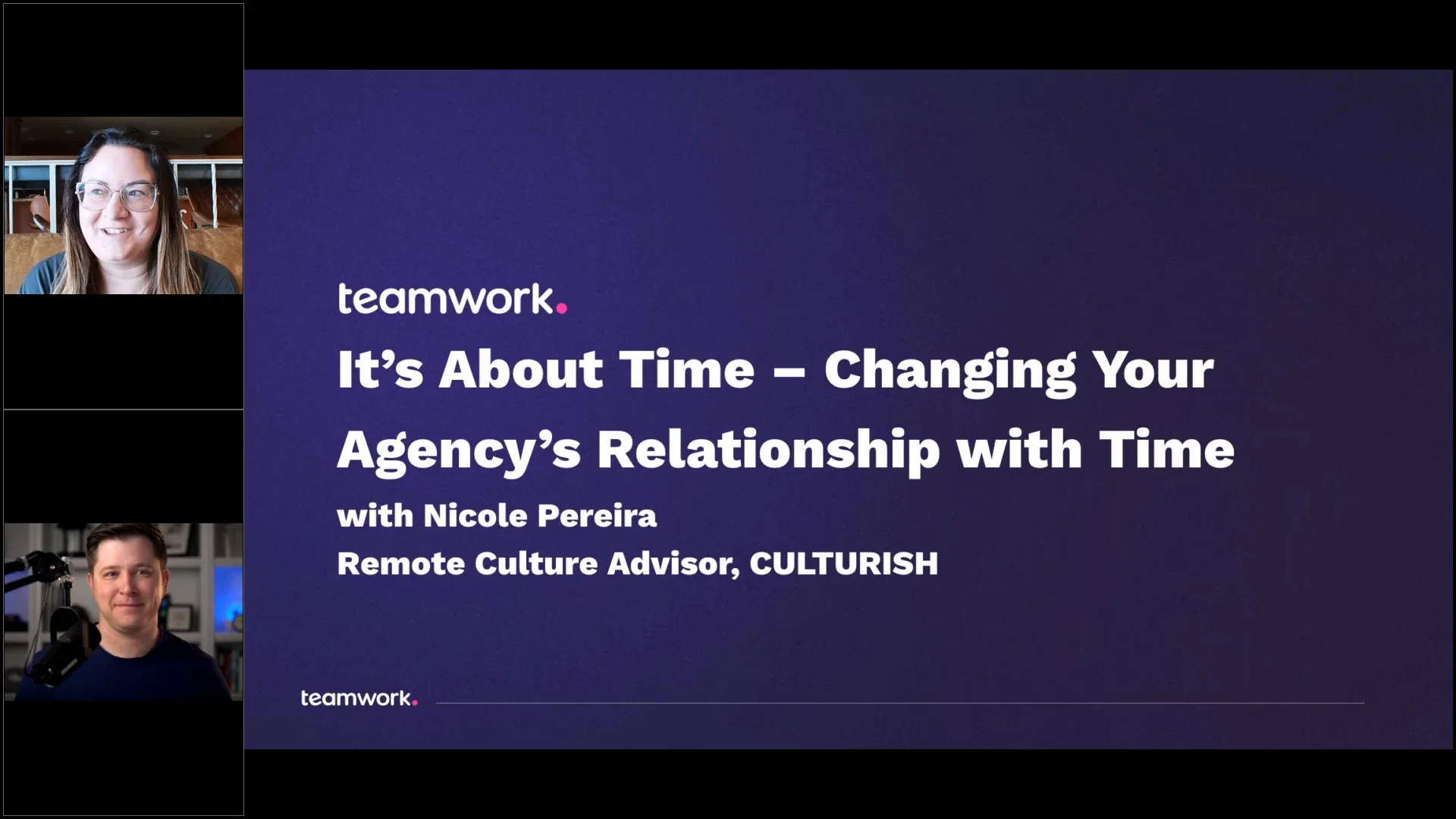
Join us on-demand for a conversation between Logan Lyles (Head of Partnerships at Teamwork) and Nicole Pereira (Remote Culture Advisor @CULTURISH) to talk about how designing time autonomy in your company can create healthier and more functional work environments.
Duration: 70 mins
)
)
)
)